
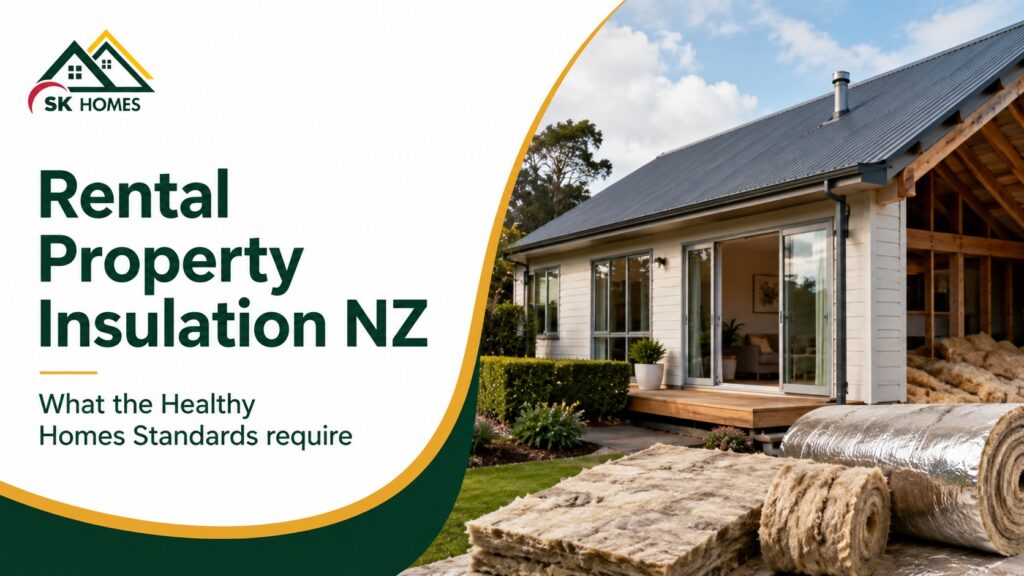
Rental Property Insulation NZ: What the Healthy Homes Standards Require
Rental property insulation NZ is one of the most important requirements under the Healthy Homes Standards. The insulation standard requires that all New Zealand rental properties have adequate ceiling insulation and underfloor insulation that meets minimum R-values for the property’s climate zone. With all compliance deadlines now passed as of 1 July 2024, landlords who have not yet upgraded their rental property insulation in NZ are at risk of significant Tenancy Tribunal penalties.
What Does the Healthy Homes Insulation Standard Require?
The insulation standard has two main components:
Ceiling Insulation
All rental properties must have ceiling insulation in every area above a habitable room. The minimum R-value depends on your climate zone:
- Climate Zone 1 (Northland coast, some Auckland islands): R2.9
- Climate Zone 2 (Most of North Island, Nelson/Marlborough): R3.3
- Climate Zone 3 (South Island, Northland highlands): R3.6
Exception: Existing ceiling insulation installed before 1 July 2016 only needs to meet R2.9 (in Zones 2 and 3) if it is in a reasonable condition, that is, not wet, not degraded, and not missing significant sections.
Underfloor Insulation
Underfloor insulation is required where the floor is a suspended timber floor above a ground-level enclosed space, and where it is reasonably practicable to install it (i.e., there is adequate subfloor access). The minimum R-value is R1.3 in all climate zones.
Underfloor insulation is not required where:
- The floor is a concrete slab
- The subfloor is not enclosed
- It is not reasonably practicable to install insulation (for example, where there is insufficient clearance for safe installation)
What Counts as “Reasonable Condition” for Existing Insulation?
Existing insulation is considered to be in reasonable condition if it:
- Is not wet or damp
- Is not significantly compressed or flattened
- Has no significant gaps or missing sections
- Is not significantly contaminated or degraded by pests
- Is installed correctly (for example, foil insulation should have the foil face upward in underfloor installations)
Insulation that fails any of these conditions must be replaced or upgraded, even if it was installed before 1 July 2016.
Common Insulation Issues in NZ Rental Properties
No Insulation at All
Many New Zealand rental properties built before 1978, when insulation first became a building code requirement, have no ceiling or underfloor insulation. These properties require a full insulation installation to meet the standard.
Degraded Fibreglass Batts
Pink fibreglass batts were the most common ceiling insulation material installed in NZ homes from the 1970s through the 1990s. Over time, these batts can become compressed, fall into gaps, or be displaced by electricians, plumbers, or pest control work. Degraded or displaced batts may not meet the required R-value even if they were compliant when first installed.
Foil Insulation Installed Incorrectly
Foil insulation was widely used in NZ homes from the 1960s through the 1990s. To be effective, foil insulation must be installed with the foil face upward (for ceiling installation) or facing down (for underfloor installation). Incorrectly installed foil does not provide the required thermal performance.
Subfloor Insulation Fallen or Displaced
Underfloor insulation in older NZ homes is frequently found to have fallen from between the joists, particularly in properties with old polythene netting as a retaining mesh. Fallen insulation provides little thermal benefit and must be reinstalled properly.
How to Get Your Rental Property Insulation Assessed
The most reliable way to confirm that your rental property’s insulation meets the Healthy Homes Standards is to have a professional healthy homes assessment carried out. SK Homes NZ Limited provides professional assessments in Auckland, Hamilton, and Palmerston North, including a detailed insulation inspection and report.
Frequently Asked Questions: Rental Property Insulation NZ
What R-value do I need for ceiling insulation in Auckland?
Auckland is in Climate Zone 2, which requires a minimum R-value of R3.3 for new ceiling insulation, or R2.9 for existing insulation installed before 1 July 2016 if it is in reasonable condition.
Does my rental property need underfloor insulation if it has a concrete slab?
No. Underfloor insulation is only required for suspended timber floors. Concrete slab floors are exempt from the underfloor insulation requirement.
Can I check my own insulation, or do I need a professional?
Landlords can inspect accessible insulation themselves, but a professional healthy homes assessor will provide a more thorough and documented assessment, which is valuable if your compliance statement is ever questioned.
What is the cost of installing ceiling insulation in a NZ rental property?
Costs vary depending on the size of the property, the insulation type, and the installer. As a rough guide, ceiling insulation for a typical three-bedroom NZ home costs between $1,500 and $3,000 installed. Underfloor insulation is typically $1,000 to $2,500.
Does old foil insulation meet the healthy homes standard?
It depends. Existing foil insulation installed before 1 July 2016 may meet the standard if it is in reasonable condition. However, foil insulation generally has a lower R-value than modern bulk insulation. A professional assessment is recommended to confirm whether your existing foil meets the required R-value.
Is there government funding to help with rental property insulation in NZ?
The Warmer Kiwi Homes programme provides subsidies for eligible homeowners (primarily owner-occupiers). Some landlords may be eligible in limited circumstances, check EECA’s website for current eligibility.
What happens if my rental property insulation doesn’t meet the standard?
You must upgrade the insulation to meet the required R-value. If you provide a compliance statement stating the property complies when it does not, you risk a Tenancy Tribunal penalty of up to $4,000.
Can a tenant request that the insulation be upgraded?
Yes. If a tenant believes the insulation in their rental does not meet the standard, they can apply to the Tenancy Tribunal, which can order the landlord to carry out an upgrade.
How do I know which climate zone my rental property is in?
The MBIE website has a climate zone map for New Zealand. Most of the North Island (including Auckland, Hamilton, and Palmerston North) is in Zone 2.
How do I book an insulation assessment for my rental property?
Contact SK Homes NZ Limited at info@skhomes.co.nz or call +64 290 4504 642 for a professional healthy homes assessment including a full insulation inspection in Auckland, Hamilton, or Palmerston North.