
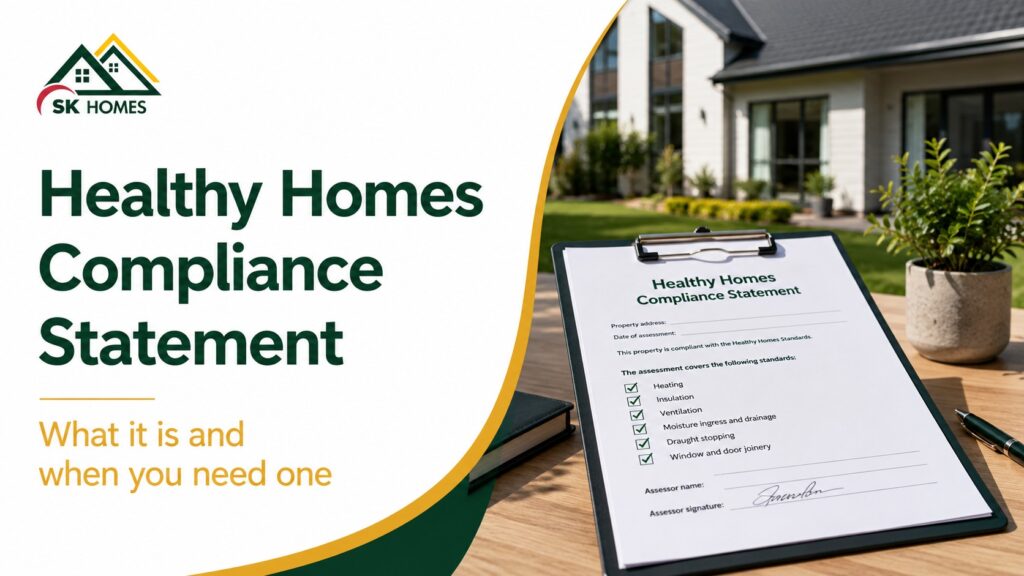
Healthy Homes Compliance Statement NZ: What It Is and When You Need One
A healthy homes compliance statement is a legal document that every New Zealand landlord must provide to their tenants as part of a tenancy agreement. If you rent out a residential property in New Zealand, understanding what a healthy homes compliance statement is, when you need one, and what it must contain is not optional, it is a legal requirement under the Residential Tenancies Act 1986, as amended by the Residential Tenancies (Healthy Homes Standards) Regulations 2019.
In this guide, we explain exactly what a healthy homes compliance statement covers, when landlords must provide it, and what happens if you get it wrong. Whether you are a first-time landlord in Auckland, an experienced property investor in Hamilton, or a rental owner in Palmerston North, this article covers everything you need to know.
What Is a Healthy Homes Compliance Statement?
A healthy homes compliance statement is a written declaration made by a landlord (or their property manager) that outlines the current state of a rental property’s compliance with each of the five Healthy Homes Standards. It must be included in, or attached to, every new or renewed tenancy agreement for a private residential rental property in New Zealand.
The statement must address each of the five Healthy Homes Standards:
- Heating Standard, whether the main living room has a qualifying fixed heater capable of heating the room to 18°C
- Insulation Standard, whether ceiling and underfloor insulation meets the required R-values and condition
- Ventilation Standard, whether extractor fans are installed in kitchens and bathrooms, and whether openable windows meet the requirements
- Moisture Ingress and Drainage Standard, whether the property has an adequate drainage system and, where required, a ground moisture barrier
- Draught Stopping Standard, whether gaps and holes in walls, floors, ceilings, windows, and doors that cause unreasonable draughts have been addressed
For each standard, the landlord must state whether the property currently complies, and if it does not comply, when compliance will be achieved.
When Must a Healthy Homes Compliance Statement Be Provided?
Under the Residential Tenancies Act, a healthy homes compliance statement must be provided in the following situations:
New Tenancy Agreements
Every new tenancy agreement for a private residential rental must include or attach a healthy homes compliance statement. This applies to both fixed-term and periodic tenancy agreements entered into on or after 1 July 2019.
Renewed or Extended Tenancy Agreements
If an existing tenancy is renewed or extended by a written agreement, a new healthy homes compliance statement must be provided to the tenant at the time of renewal.
Assignment of Tenancy
Where a tenancy is assigned to a new tenant, the landlord must provide an updated compliance statement to the incoming tenant.
What Are the Compliance Deadlines for the Healthy Homes Standards?
New Zealand landlords have been required to comply with the Healthy Homes Standards on the following timeline:
- 1 July 2021, All private landlords must include a healthy homes compliance statement in new or renewed tenancy agreements
- 1 July 2021, All Kāinga Ora (Housing New Zealand) properties must comply with all five standards
- 1 July 2021, All registered Community Housing Provider properties must comply
- 1 July 2024, All private rental properties must comply with all five Healthy Homes Standards
As of 1 July 2024, every private rental property in New Zealand must meet all five Healthy Homes Standards, regardless of when the current tenancy began. This means that if your rental property does not currently meet the standards, you are already in breach of the law.
What Happens If a Landlord Provides a False or Misleading Compliance Statement?
The Residential Tenancies Act treats a false or misleading healthy homes compliance statement very seriously. If a landlord knowingly provides inaccurate information in their compliance statement, they may be liable for:
- A financial penalty of up to $4,000 per breach for a private landlord
- An order by the Tenancy Tribunal to bring the property into compliance
- Exemplary damages in cases of particularly serious non-compliance
It is important to note that “I didn’t know” is not a defence under New Zealand tenancy law. Landlords are expected to take reasonable steps to understand the requirements and accurately complete the compliance statement.
How to Complete a Healthy Homes Compliance Statement
The compliance statement must be completed accurately and honestly. Here is what you need to do for each standard:
Heating Standard
Measure the main living room and use the MBIE heating assessment tool to determine the required heating capacity in kilowatts. Check whether your existing fixed heater (if any) meets the required capacity. If it does not, you must install a qualifying heater and note the date by which this will be done.
Insulation Standard
Check whether ceiling and underfloor insulation is present, in a reasonable condition (not damaged, wet, or missing), and whether it meets the required R-values for your climate zone. New Zealand has three climate zones with different R-value requirements.
Ventilation Standard
Check that all kitchens and bathrooms have functioning extraction fans that vent directly to the outside. Check that all habitable rooms have opening windows that meet the required ratio of floor area (typically at least 5% of the floor area must be openable).
Moisture Ingress and Drainage Standard
Check that gutters, downpipes, and drainage are functioning and free of blockages. If the property has an enclosed subfloor, check whether a ground moisture barrier (polythene sheet) is installed and in good condition.
Draught Stopping Standard
Walk through the property and check for unreasonable gaps around doors, windows, unused fireplaces, and in floors, walls, and ceilings. Any gaps that cause draughts must be addressed.
Getting a Professional Healthy Homes Assessment
While landlords can complete a healthy homes compliance statement themselves, many choose to use a professional assessor to ensure accuracy and avoid the risk of penalties for an incorrect statement. A professional healthy homes assessment from SK Homes NZ Limited includes:
- A thorough inspection of all five Healthy Homes Standards
- Measurement of the main living room and heating capacity calculation using the MBIE tool
- Assessment of insulation condition and R-values
- Ventilation, moisture, and draught inspection
- A detailed written report documenting current compliance and any required remedial work
- Guidance on what needs to be done to achieve full compliance
Having a professional assessment completed by a qualified assessor like SK Homes gives you documented evidence of your compliance efforts, which can be valuable if your compliance statement is ever challenged at the Tenancy Tribunal.
Common Mistakes Landlords Make With Compliance Statements
Leaving Sections Incomplete
Every section of the compliance statement must be completed. Leaving any standard blank is not acceptable and may result in a penalty.
Stating Future Dates Without a Plan
If your property does not currently comply with a standard, you can note a future compliance date, but only if you have a genuine, reasonable plan to achieve compliance by that date. Stating a future date without any intention of meeting it constitutes a false statement.
Copying a Previous Statement Without Updating It
Each new or renewed tenancy requires a fresh, accurate compliance statement reflecting the current state of the property. Copying an old statement without verifying that the information is still accurate is a common and potentially costly mistake.
Forgetting to Include It in the Tenancy Agreement
The compliance statement must be included in or attached to the signed tenancy agreement. Sending it separately after signing, or failing to include it at all, is a breach of the tenancy law requirements.
Frequently Asked Questions: Healthy Homes Compliance Statement NZ
Is a healthy homes compliance statement required for all rental properties?
Yes. All private residential rental properties in New Zealand require a healthy homes compliance statement in any new or renewed tenancy agreement signed on or after 1 July 2019.
Does the compliance statement need to be signed?
The compliance statement must be included in or attached to the tenancy agreement, which both landlord and tenant sign. There is no separate signing requirement for the compliance statement itself, but it must be part of the signed agreement.
What is the penalty for not providing a healthy homes compliance statement?
Failing to include a compliance statement, or providing a false or misleading statement, can result in a financial penalty of up to $4,000 per breach through the Tenancy Tribunal.
Can a property manager complete the compliance statement on behalf of the landlord?
Yes. A property manager can complete the compliance statement on the landlord’s behalf. However, the landlord remains legally responsible for the accuracy of the statement.
Do I need a new compliance statement for every tenancy renewal?
Yes. A new, accurate compliance statement must be provided at each tenancy renewal. It must reflect the current state of compliance at the time of renewal, not a previous assessment.
What if the property doesn’t comply yet, can I still rent it out?
As of 1 July 2024, all private rental properties must comply with all five Healthy Homes Standards. You cannot state in a compliance statement that your property will comply in the future if the deadline has already passed.
Does a holiday home or short-term rental need a compliance statement?
Short-term holiday rentals (typically under 28 days) are generally exempt from the Residential Tenancies Act requirements. However, any property rented on a residential basis for 28 days or more requires compliance with the Healthy Homes Standards.
How do I know what R-value my insulation needs to be?
The required R-value depends on your property’s climate zone and where the insulation is located (ceiling or underfloor). The MBIE website provides a climate zone map and R-value requirements. A professional healthy homes assessor can assess your insulation and confirm whether it meets the required values.
Can a tenant request to see the compliance statement after signing?
Yes. Tenants have the right to request a copy of the tenancy agreement (which must include the compliance statement) at any time during the tenancy. Landlords must provide a copy within a reasonable timeframe.
Where can I find the official healthy homes compliance statement template?
Tenancy Services New Zealand provides an official compliance statement template at tenancy.govt.nz. This template is updated when the law changes, so always use the most current version.