
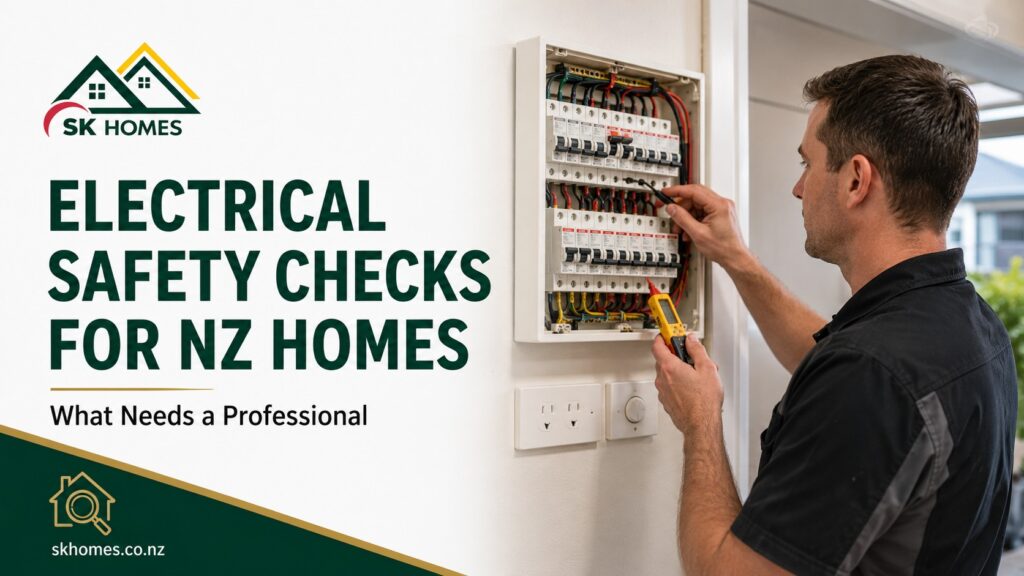
Electrical Safety Checks for NZ Homes: What Needs a Professional
Electrical safety checks for NZ homes are an essential part of responsible homeownership, yet they are one of the most overlooked aspects of property maintenance. Whether you live in an older villa in Auckland or a newer home in Palmerston North, knowing when to call a registered electrician could prevent fires, electrocution, and costly rewiring work.
Electrical faults are one of the leading causes of house fires in New Zealand. Yet electrical safety is one of the least understood areas of home maintenance for most NZ homeowners. Unlike a leaking tap or a cracked window, electrical problems are largely invisible – they live behind wall linings, in the roof space, and in the switchboard. The consequences of ignoring them range from higher power bills to house fires and electrocution fatalities.
This article covers what homeowners can safely check themselves, what requires a Registered Electrician, and the specific electrical safety issues BRANZ and Fire and Emergency NZ identify as highest risk in residential properties.
NZ Electrical Regulations
All electrical work in NZ must be carried out by a Registered Electrician (or supervised apprentice) under the Electricity Act 1992 and the Electrical Workers Registration Act 2010. DIY electrical work – wiring, circuit installation, switchboard work – is illegal for homeowners in NZ. Even licensed electricians from other countries must be registered in NZ before carrying out electrical work. This is not bureaucracy for its own sake: it protects homeowners from fires and electrocution caused by substandard wiring.
What Homeowners Can Safely Check
Safety Switches (RCDs)
Residual Current Devices (RCDs, also called safety switches) are the most important electrical safety device in a NZ home. They detect earth leakage current and trip the circuit within milliseconds – fast enough to prevent electrocution. Most modern NZ switchboards have RCD protection on some or all circuits. Check yours: open the switchboard cover and look for switches labelled “RCD”, “RCCB”, or with a test button marked “T” or “Test”.
Test RCDs monthly: press the test button firmly. The switch should trip immediately. Reset it by switching it back on. If the RCD does not trip when tested, it has failed and should be replaced by a Registered Electrician as soon as possible.
Smoke Alarms
Under NZ law, all residential properties must have working smoke alarms. Test monthly using the test button. Replace batteries annually for battery-operated alarms (unless sealed 10-year models). Replace the entire unit every 10 years – the sensor degrades over time. Interconnected alarms (where one triggers all) provide better protection and are now standard in new construction and required for rental properties.
Power Points and Switches
Look for: discolouration (brown or black scorch marks) around power points or light switches, power points or switches that are warm to the touch when nothing is plugged in, cracked or broken faceplates, or power points that are loose in the wall. Any of these indicate a fault that needs a Registered Electrician. Do not plug anything into a damaged or discoloured power point.
Extension Cords and Power Boards
Check extension cords for damage, cracking, or exposed copper. Do not use damaged cords. Do not run extension cords under carpets or rugs (they can overheat). Do not piggyback one power board into another. If you rely on multiple extension cords and power boards in a room, this is a sign that your home needs more power points – a Registered Electrician can add circuits and power points.
What Requires a Registered Electrician
- Any new wiring, circuit installation, or changes to the switchboard
- Adding or relocating power points or light fittings
- Installing a heat pump, electric vehicle charger, or kitchen appliance that requires a dedicated circuit
- Upgrading from an old fuse board to a modern circuit breaker switchboard with RCD protection
- Replacing failed or aging wiring – particularly relevant for pre-1970 homes with original wiring
- Any repair to damaged wiring or electrical fault investigation
- Installation of switchboard RCDs if not currently present
High-Risk Electrical Issues in Older NZ Homes
Old Fuse Boards
Many older Auckland, Hamilton, and Palmerston North homes still have original ceramic fuse boards or early circuit breaker boards without RCD protection. These boards do not provide the same level of protection against electrical fires and electrocution as modern switchboards. Upgrading to a modern switchboard with RCD protection on all circuits is one of the most important electrical safety investments a homeowner with an older home can make. Budget $1,500 to $3,500 for a switchboard upgrade including RCDs.
Rewirable Fuses
Some older fuse boards use rewirable fuses – ceramic fuse holders where the fuse wire can be replaced by the homeowner. These can be installed with incorrect fuse wire (too heavy a rating), which means the fuse does not blow when it should, allowing overloads to cause fires. If your home has rewirable fuses, upgrading to circuit breakers with RCD protection is strongly recommended.
Aluminium Wiring
Some NZ homes built in the 1960s and 1970s have aluminium wiring rather than copper. Aluminium wiring is not inherently unsafe, but it requires specific fittings and connections rated for aluminium. Loose connections, incorrect fittings, and corrosion at connection points are fire risks. If your pre-1980s home has aluminium wiring, it should be inspected by a Registered Electrician.
Frequently Asked Questions
Do I need RCDs on every circuit in my NZ home?
The current NZ Electrical Code requires RCD protection on socket outlet circuits (power points) and lighting circuits. Older homes may have been wired before these requirements applied. An electrician can assess your current switchboard and advise on what RCD protection is present and what upgrades are recommended.
How do I know if my wiring is safe?
A Registered Electrician can conduct an electrical safety inspection of your home’s wiring and switchboard, assessing the condition and safety of the installation. There is no single certification equivalent to a building inspection for residential electrical systems, but a professional assessment is the best way to understand the safety of an older installation.
What should I do if a circuit breaker keeps tripping?
A circuit breaker that trips repeatedly is indicating an overloaded circuit or a fault. Do not tape the breaker in the on position or use a higher-rated fuse to stop it tripping – this removes the protection the device provides. Identify what is on the circuit and reduce the load, or call a Registered Electrician to investigate the fault.
How much does a switchboard upgrade cost in NZ?
A standard switchboard upgrade to a modern unit with circuit breakers and RCD protection typically costs $1,500 to $3,500 in Auckland, depending on the size of the installation and the number of circuits. This is one of the most worthwhile safety investments in an older NZ home.
Does installing a heat pump require an electrician?
Yes. Heat pump installation involves both a refrigeration technician (for the refrigerant circuit) and a Registered Electrician (for the power connection). These may be the same person if they hold both licences, or separate contractors. The electrical connection to the switchboard is restricted electrical work and cannot be done by an unlicensed person.
Need a professional property inspection or Healthy Homes assessment in Auckland, Hamilton, or Palmerston North? Contact SK Homes NZ Limited at info@skhomes.co.nz or visit skhomes.co.nz – we help NZ homeowners and landlords keep their properties safe, compliant, and well maintained.