
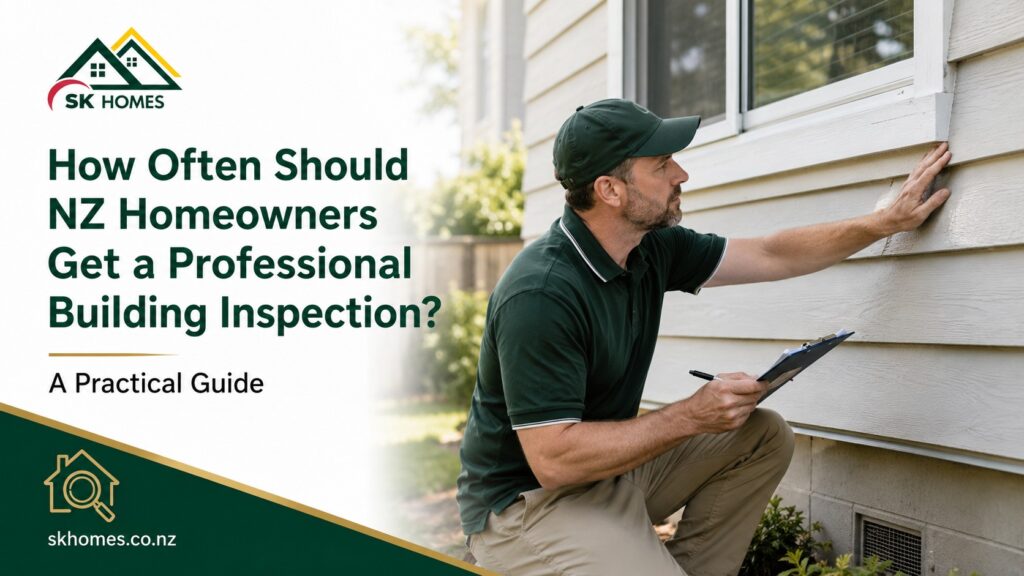
How Often Should NZ Homeowners Get Building Inspection?
How often should NZ homeowners get building inspection is one of the most common property questions. The right frequency depends on your property age, cladding type, and condition.
How often should NZ homeowners get building inspection is one of the most important property questions. The right frequency depends on your property age, type, and condition.
How often should NZ homeowners get a building inspection? The answer depends on the age and condition of your property, but regular professional inspections are one of the most effective ways to protect your investment.
How often NZ homeowners should get a building inspection is a question that protects your investment long after purchase. Understanding the right inspection frequency helps identify defects before they become costly repairs.
How often NZ homeowners building inspection schedules should be reviewed is a question most people only consider when buying a property, yet regular professional inspections protect your investment long after purchase.
often every NZ homeowners building inspection should be scheduled is a question most people only consider when buying a property, not as a regular maintenance practice.
Most New Zealanders think about building inspections in the context of buying a property. The pre-purchase inspection is now standard practice for most Auckland and Hamilton buyers – but the inspection at purchase is the beginning of a maintenance story, not the end of it. For homeowners who have already bought, the question becomes: how often do I actually need a professional inspection of my own home?
The answer depends on several factors: the age of the property, the construction type, the local climate, and the history of maintenance. BRANZ guidance and experienced NZ building professionals generally recommend professional inspections at intervals of three to ten years for residential properties, with the shorter end of that range for older or higher-risk properties.
Why Annual DIY Checks Are Not Enough
The annual maintenance checklist – clearing gutters, checking caulking, testing extractor fans – is essential and every homeowner should do it. But an annual DIY check has significant limitations. Most homeowners cannot safely access the roof space and subfloor. They do not have moisture meters to detect concealed moisture in walls. They may not recognise the early signs of structural movement or weathertightness failure. And they lack the comparative experience to judge whether what they are looking at is normal or a developing problem.
A professional building inspector brings specialist knowledge, equipment, and the ability to access and assess areas that homeowners typically cannot. They can detect problems that are invisible to an untrained eye – and detect them early, when they are still cheap to fix.
Recommended Frequency by Property Type
Pre-1970 Homes
Every three to five years. Older homes have original building materials that are approaching or beyond their design life. Timber weatherboards, original roofing, lead flashings, galvanised plumbing, and original wiring all require more frequent professional assessment. These properties also typically have suspended timber floors with subfloor spaces that accumulate moisture and timber decay that is invisible from inside the house.
1970-1990 Homes
Every five years. This era covers a significant portion of Auckland, Hamilton, and Palmerston North housing stock. Properties from this period often have fibrolite or asbestos-containing materials (particularly in ceilings, floor vinyl, and insulation), and building methods that, while adequate, are now aging. Five-yearly professional inspections are appropriate.
1990-2005 Homes (Leaky Building Era)
Every three years minimum. Properties built during this period – particularly those with monolithic cladding systems, flat or low-pitch roofs, and poor weathertightness detailing – carry the highest ongoing risk of concealed moisture damage. Even where a property has been remediated, ongoing professional monitoring is important. The BRANZ research on leaky buildings repeatedly shows that moisture damage continues to develop in high-risk properties even after partial remediation.
Post-2005 Homes
Every seven to ten years. Properties built after the Building Act 2004 reforms and the improved Building Code weathertightness provisions carry lower risk. However, building defects still occur – consent failures, substandard workmanship, and material failures are not unknown in modern construction. A professional inspection at five to seven years and ten years provides appropriate assurance for well-maintained modern homes.
Events That Should Trigger an Unscheduled Inspection
Outside the regular schedule, certain events should prompt a professional inspection regardless of when the last one was done:
- After a significant earthquake (above magnitude 5.0 at close range)
- After major flooding or storm damage
- When you notice new cracking in walls, floors, or foundations
- When ceiling or wall staining appears after rain
- When a damp or musty smell develops in rooms that were previously dry
- When floors become noticeably springy or soft in areas
- When you are planning a renovation that involves removing wall linings or opening the building envelope
- Before selling the property – a pre-sale inspection allows you to address issues before they appear on the buyer’s inspection report
What a Periodic Homeowner Inspection Covers
A professional periodic maintenance inspection by SK Homes NZ covers the same areas as a pre-purchase inspection – roof exterior and roof space, exterior cladding and joinery, subfloor (where accessible), interior spaces, and visible services. The key difference from a pre-purchase inspection is the context: the inspector knows the property’s history, has your last report as a reference point, and can identify changes in condition over time.
The output is a written condition report identifying any defects found, their severity, and recommended actions. For properties with known issues, the report provides a documented record of the property’s maintenance history – which is valuable when you come to sell.
Region-Specific Advice
Auckland
High humidity year-round accelerates timber decay and weathertightness deterioration. Monolithic cladding homes in Auckland should be inspected every three years. The number of leaky buildings still in Auckland’s housing stock without complete remediation is significant – ongoing professional monitoring is essential for any property in this category.
Hamilton
Cold winters and high rates of older state housing stock make periodic inspections particularly important for Hamilton homeowners. The Waikato region has significant earthquake risk as well – Hamilton homeowners should arrange a post-earthquake inspection after any significant seismic event.
Palmerston North
Wind-driven rain is a persistent weathertightness risk in the Manawatu. Older villa and bungalow stock is common and typically has painted weatherboard cladding that requires regular painting to maintain weathertightness. Every five years is appropriate for most Palmerston North properties, more frequently for older or poorly maintained homes.
Frequently Asked Questions
Is there a legal requirement to get my home professionally inspected?
No. Professional building inspections for owner-occupied homes are not legally required in NZ. However, for rental properties, Healthy Homes assessments are legally required to demonstrate compliance with the Healthy Homes Standards. For any building work requiring a building consent, council inspections are required at specific stages.
What is the difference between a council inspection and a professional building inspection?
A council inspection (by a building consent authority) checks compliance with specific building consent conditions at defined stages of construction. A professional building inspection by a company like SK Homes NZ is a condition assessment of the whole building – it covers areas and systems that council inspections do not, and is not limited to consent work.
How much does a periodic homeowner inspection cost?
SK Homes NZ pre-purchase and maintenance inspections start from $450 + GST for a standard residential property. This is significantly less than the cost of repairing damage that goes undetected for five extra years.
Should I get an inspection before renovating?
Yes – particularly before any renovation that involves removing wall linings or working on the exterior. A pre-renovation inspection can identify issues (like concealed moisture in walls, subfloor problems, or asbestos in older materials) that need to be addressed before or during the renovation work.
Is a building inspection the same as a building warrant of fitness?
No. A Building Warrant of Fitness (BWOF) applies to commercial buildings with specified systems (fire suppression, lifts, etc.) and is issued annually based on compliance with an inspection maintenance programme. It does not apply to standard residential properties.
Need a professional property inspection or Healthy Homes assessment in Auckland, Hamilton, or Palmerston North? Contact SK Homes NZ Limited at info@skhomes.co.nz or visit skhomes.co.nz – we help NZ homeowners and landlords keep their properties safe, compliant, and well maintained.
Related Articles
- Your Annual NZ Home Maintenance Checklist
- When to Call a Builder vs a Building Inspector in NZ
- What is a Pre-Purchase Building Inspection in NZ?
When to Book Your Next Inspection
If it has been more than five years since your last professional building inspection, or if you have experienced any significant weather events, consider booking a check-up with SK Homes NZ. Early detection of issues such as subfloor moisture, roof deterioration, or weathertightness defects can save thousands in remediation costs. Contact us at info@skhomes.co.nz or call +64 290 4504 642 to arrange a professional inspection across Auckland, Hamilton, or Palmerston North.
How Often Should NZ Homeowners Get Building Inspection: BRANZ Guidance
How often should NZ homeowners get building inspection is addressed in BRANZ guidance on residential property maintenance, which recommends periodic professional assessments based on property age, cladding type, and previous inspection findings. According to BRANZ, proactive maintenance inspection is one of the most cost-effective strategies for preserving property value in New Zealand.