
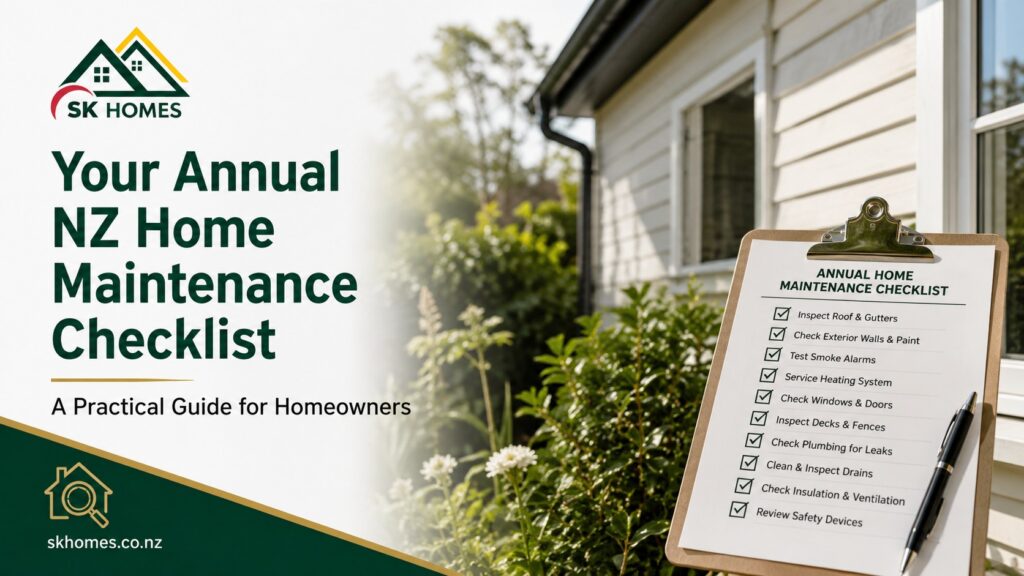
Annual NZ Home Maintenance Checklist: What to Inspect Each Year
An annual NZ home maintenance checklist is essential because New Zealand homes face some of the most demanding conditions of any housing stock in the world.
New Zealand homes face some of the most demanding conditions of any housing stock in the world. Seismic activity, high rainfall, coastal salt exposure, and significant humidity variation from region to region all place ongoing stress on building materials and systems. According to BRANZ (Building Research Association of New Zealand), regular maintenance is the single most cost-effective way to protect the long-term value and livability of a residential property. The cost of deferred maintenance compounds significantly over time – what a $200 gutter repair prevents today can become a $15,000 subfloor remediation job in five years.
This checklist covers what NZ homeowners should inspect every year, region-specific considerations for Auckland, Hamilton, and Palmerston North, and which professional to call for each type of issue.
Why Annual Inspections Matter in NZ
BRANZ research consistently identifies moisture as the leading cause of building defects in New Zealand homes. Annual checks allow homeowners to catch water ingress, subfloor moisture build-up, and weathertightness failures before they become structural problems. The Building Act 2004 and associated New Zealand Building Code require buildings to remain weathertight and structurally sound – but enforcement is reactive. It is the homeowner who carries the cost when maintenance is neglected.
Roof and Guttering
Inspect annually, ideally before winter.
- Check roof cladding for cracked, loose, or missing tiles and sheets
- Inspect flashings around chimneys, skylights, and penetrations for lifting or cracking
- Clear gutters and downpipes of leaves and debris
- Check downpipes discharge to drains rather than onto the ground
- Look for rust or corrosion on metal roof elements and gutters
- Inspect the roof space from inside for daylight penetration or water staining on rafters
Who to call: Roofing Specialist for repairs, Licensed Building Practitioner (LBP) for structural roof work, Building Inspector for an independent condition report.
Exterior Cladding and Joinery
Inspect annually. Critical for monolithic cladding homes (1992-2004 construction era).
- Check all caulking and sealant joints around windows, doors, and penetrations for cracking or shrinkage
- Look for paint peeling or bubbling, which often indicates moisture behind the surface
- Check window and door frames for rot at the base, particularly at sill level
- Inspect cladding for cracks, gaps at joints, or areas where the cladding meets the foundation
- Check deck flashings and waterproofing membranes for cracking
Who to call: LBP for cladding repairs, Building Inspector for weathertightness condition assessment, Waterproofing Specialist for deck and below-ground moisture.
Subfloor and Foundation
Inspect annually for homes with suspended timber floors.
- Access the subfloor and check for standing water or very wet ground conditions
- Check the ground moisture barrier (polythene) for damage or gaps
- Inspect floor joists and bearers for visible moisture damage, soft spots, or early decay
- Check subfloor vents are open and unobstructed
- Look for pest evidence – borer holes in timber, mud tubes from subterranean termites
Who to call: Building Inspector for subfloor condition assessment, LBP for structural timber repairs, Waterproofing Specialist for persistent moisture issues.
Interior Moisture and Ventilation
- Check bathroom and kitchen extractor fans are operational and venting to outside
- Look for condensation staining or mould in window reveals, ceiling corners, and external wall surfaces
- Check ceiling for water staining – brown rings or discolouration indicate past or current roof leaks
- Check under sinks and around toilets for slow leaks
Who to call: Registered Plumber for leaks, Healthy Homes Assessor for rental compliance and insulation, Building Inspector for moisture investigation.
Electrical
- Test all safety switches (RCDs) monthly using the test button
- Check smoke alarms are working (test monthly, replace batteries annually, replace units every 10 years)
- Look for any scorch marks, discolouration, or burning smell near power outlets or switchboard
- Ensure the switchboard has RCD protection (required for all circuits under current NZ standards)
Who to call: Registered Electrician for any electrical repairs, faults, or safety upgrades.
Plumbing and Hot Water
- Check hot water cylinder for any signs of corrosion, scale build-up around fittings, or water on the floor nearby
- Check all tap washers and toilet cisterns for drips or running water
- Check outdoor taps and irrigation systems before summer
- Clear any blocked drains in kitchens, bathrooms, and laundries
Who to call: Registered Plumber for all plumbing repairs and hot water system work.
Region-Specific Considerations
Auckland
High humidity year-round and a large number of leaky-era homes (monolithic cladding, 1992-2004) make annual weathertightness checks critical. Pay particular attention to caulking, sealants, and deck membranes. Subfloor moisture is extremely common in North Shore, West Auckland, and older central suburbs.
Hamilton
Cold winters, older housing stock, and high rates of subfloor moisture in older state housing. Frost risk in winter means pipe lagging in exposed areas should be checked. Older Waikato homes often have original hot water cylinders well beyond their service life.
Palmerston North and the Manawatu
Wind-driven rain is a significant weathertightness risk. Older villa and bungalow stock is common – check painted weatherboards for peeling and bare timber exposure. Frost risk in winter, particularly in low-lying areas. Subfloor access is often difficult in older properties.
Frequently Asked Questions
How often should I get a professional building inspection for my own home?
BRANZ recommends a professional inspection every five to ten years for well-maintained homes. For older homes or homes with known weathertightness risk, every three to five years is more appropriate. An annual DIY check using this checklist helps catch issues between professional inspections.
What is the most important maintenance task for an Auckland home?
Weathertightness maintenance – specifically keeping sealants, caulking, and flashings in good condition around windows, doors, and roof penetrations. Auckland’s humidity and the prevalence of leaky-era construction makes this the single highest-risk area for Auckland homeowners.
What is a Licensed Building Practitioner (LBP) and when do I need one?
An LBP is a building professional licensed under the Building Act 2004 to carry out or supervise restricted building work – work that affects the primary structure or weathertightness of a building. You need an LBP for structural repairs, cladding replacement, and roofing work.
Can I inspect the subfloor myself?
You can make a visual check through the subfloor hatch, but a full subfloor inspection requires entering the space – which involves confined space conditions and potential health risks (dust, mould, pests, asbestos in older homes). A professional building inspector is better placed to conduct a thorough subfloor inspection safely.
How do I find a reliable building inspector in Auckland?
Look for inspectors who operate to NZS 4306:2005 (the NZ Standard for residential property inspection), hold professional indemnity insurance, and provide a full written report. SK Homes NZ provides professional building inspections and Healthy Homes assessments across Auckland, Hamilton, and Palmerston North.
What is the difference between a building inspector and an LBP?
A building inspector assesses the condition of a building and provides a written report – they identify problems and advise on remediation. An LBP carries out building work. You use a building inspector to understand what is wrong; you use an LBP to fix it.
Do smoke alarms need professional maintenance?
No – smoke alarm maintenance is a homeowner responsibility. Test monthly, replace batteries annually (unless sealed unit), and replace the unit every 10 years. Under NZ law (Fire and Emergency NZ Act), rental properties must have working smoke alarms.
How much does annual home maintenance typically cost in NZ?
BRANZ guidance suggests budgeting 1-2% of the home’s value per year for maintenance. On a $900,000 Auckland home, that is $9,000 to $18,000 per year. Most years the spend will be far less than this, but the budget should be available for when significant maintenance is required.
Is gutter cleaning something I can do myself?
For single-storey homes with safe roof access, gutter cleaning is within most homeowner’s capabilities. For two-storey or steeply pitched roofs, hire a professional gutter cleaning service. Working at height is one of the leading causes of serious injury in residential maintenance – do not take unnecessary risks.
What maintenance records should I keep?
Keep records of all building inspections, repairs, and maintenance work – including date, who did the work, and what was done. For rental properties, maintenance records are essential evidence in Tenancy Tribunal matters. For homeowners, they provide valuable information for future buyers and help track the property’s maintenance history.
Need a professional property inspection or Healthy Homes assessment in Auckland, Hamilton, or Palmerston North? Contact SK Homes NZ Limited at info@skhomes.co.nz or visit skhomes.co.nz – we help NZ homeowners and landlords keep their properties safe, compliant, and well maintained.
Related Articles
- How Often Should NZ Homeowners Get a Professional Building Inspection?
- Roof Maintenance in NZ
- Weathertightness Maintenance
Annual NZ Home Maintenance Checklist: Key Points for NZ Property Owners
The annual NZ home maintenance checklist supported by BRANZ research emphasises that regular inspections prevent costly structural deterioration in New Zealand’s variable climate conditions. For more information, visit BRANZ.