
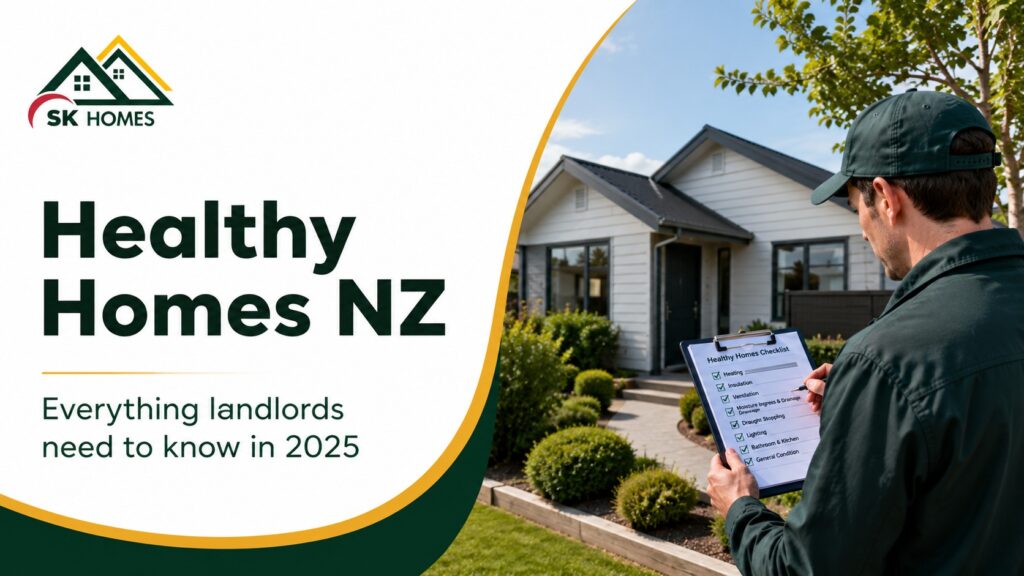
Healthy Homes NZ: Everything Landlords Need to Know in 2025
Healthy homes NZ is the term used to describe the five legal standards that all New Zealand landlords must meet in their rental properties under the Residential Tenancies (Healthy Homes Standards) Regulations 2019. Since 1 July 2024, every private rental property must comply with all five healthy homes standards, and understanding what is required is essential for every NZ landlord in 2025.
This guide explains the healthy homes NZ framework in plain English, covering what each standard requires, the compliance deadlines, penalties for non-compliance, and how to get professional help in Auckland, Hamilton, and Palmerston North.
What Are the Healthy Homes Standards in NZ?
The five Healthy Homes Standards are legally binding minimum requirements for New Zealand rental properties:
- Heating Standard, A qualifying fixed heater in the main living room capable of heating to at least 18°C
- Insulation Standard, Adequate ceiling and underfloor insulation meeting minimum R-values for your climate zone
- Ventilation Standard, Extractor fans in kitchens and bathrooms, and adequate openable windows in habitable rooms
- Moisture Ingress and Drainage Standard, Functioning drainage and a ground moisture barrier in enclosed subfloors
- Draught Stopping Standard, Gaps and holes that cause unreasonable draughts must be sealed
Who Do the Healthy Homes Standards Apply To?
The standards apply to all private residential landlords in New Zealand. This includes individual property investors, property management companies managing rental properties, and any person who rents out a residential property under the Residential Tenancies Act 1986.
The standards do not apply to owner-occupied homes, commercial properties, or holiday accommodation rented for less than 28 consecutive days.
Compliance Deadlines: Where Does NZ Stand in 2025?
All compliance deadlines have now passed. As of 1 July 2024, all private rental properties in New Zealand must comply with all five Healthy Homes Standards. There are no remaining grace periods or extensions. Landlords who have not yet achieved compliance are already in breach of the law and at risk of Tenancy Tribunal penalties.
What Are the Penalties for Non-Compliance in 2025?
The Tenancy Tribunal can impose the following penalties for healthy homes non-compliance:
- Financial penalties of up to $7,200 per breach for private landlords
- Up to $50,000 for body corporates
- Orders to carry out remedial work within a specified timeframe
- Exemplary damages in cases of serious or repeated non-compliance
Penalties are per breach, meaning a property that fails multiple standards could face multiple simultaneous penalties.
How to Check Whether Your Rental Property Complies
The most reliable way to confirm compliance is to have a professional healthy homes assessment carried out by a qualified assessor. SK Homes NZ Limited provides professional healthy homes assessments in Auckland, Hamilton, and Palmerston North, with a detailed written report covering all five standards and clear guidance on any required remedial work.
Common Reasons NZ Rental Properties Fail Healthy Homes Standards
Heating Failures
Many older NZ rental properties have fixed heaters that are too small for the main living room, or that have been replaced with portable heaters that do not qualify. Unflued gas heaters, once common in older NZ homes, must be removed entirely.
Insulation Deficiencies
Pre-1978 NZ homes were often built without any insulation. Even properties insulated in the 1990s and early 2000s may have insulation that has degraded, been disturbed, or no longer meets the required R-values.
Ventilation Gaps
Many older kitchens and bathrooms have recirculating range hoods rather than genuine extractor fans that vent to the outside. Recirculating hoods do not meet the ventilation standard.
Subfloor Moisture Issues
Older NZ homes with suspended timber floors often have no ground moisture barrier in the subfloor, or have barriers that are damaged, displaced, or incomplete.
Frequently Asked Questions: Healthy Homes NZ 2025
Is healthy homes NZ a government requirement?
Yes. The Healthy Homes Standards are a legal requirement under the Residential Tenancies (Healthy Homes Standards) Regulations 2019, which is secondary legislation under the Residential Tenancies Act 1986.
What happens if a tenant moves in and the property doesn’t comply?
The landlord remains legally responsible for compliance regardless of when the tenant moved in. A non-compliant property can be reported to Tenancy Services, and the landlord may face Tribunal action and financial penalties.
Can I pass healthy homes compliance costs on to my tenants?
No. The cost of achieving healthy homes compliance is the landlord’s responsibility and cannot be passed on to tenants, either through increased rent or direct charges.
Do the healthy homes standards apply to rental properties managed by property managers?
Yes. The landlord remains responsible for compliance even if a property manager is managing the property. Both the landlord and property manager may be liable if a compliance statement is false or misleading.
Are body corporate rental apartments subject to the healthy homes standards?
Yes, but the responsibility for some standards may be shared between the body corporate and individual unit owners. This is a complex area, seek legal advice specific to your situation.
Where can I find official healthy homes NZ information?
Tenancy Services New Zealand at tenancy.govt.nz is the official source. MBIE also provides technical guidance and the heating assessment tool.
Does healthy homes apply to flatmates renting rooms in a shared house?
If the tenants have an individual tenancy agreement (not a boarding house arrangement), the Healthy Homes Standards apply. Boarding house tenancies have their own rules.
How long does it take to bring a property into healthy homes compliance?
This depends on what work is needed. Draught stopping can often be completed in a day. Insulation installation typically takes half a day to a full day. Heat pump installation usually takes 4-8 hours. Allow sufficient lead time for contractors, especially during winter when demand is high.
Can I appeal a Tenancy Tribunal decision about healthy homes?
Yes. Tenancy Tribunal decisions can be appealed to the District Court on a question of law.
How do I book a healthy homes assessment with SK Homes?
Contact SK Homes NZ Limited at info@skhomes.co.nz or call +64 290 4504 642. We serve Auckland, Hamilton, and Palmerston North.