
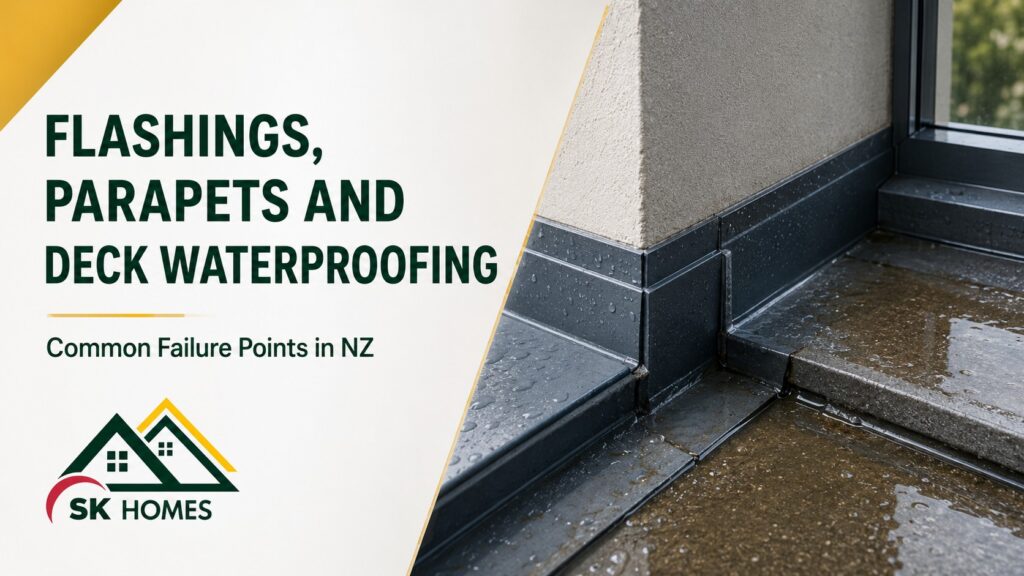
Flashings, Parapets and Deck Waterproofing: Common Failure Points in NZ
Flashings, parapets and deck waterproofing are among the most common failure points identified in New Zealand weathertightness investigations.
If you looked at all the weathertightness failures investigated by the Weathertight Homes Resolution Service, one pattern emerges clearly: most of them involved failures at junctions rather than failures in the middle of a cladding surface. Water gets into NZ homes at the points where two different materials meet, where the plane of the building changes direction, and where elements like windows, decks, and chimneys penetrate or connect to the building envelope. Flashings, parapets, and deck waterproofing are the three categories that appear most consistently in weathertightness failure investigations.
Flashings – What They Are and Why They Fail
A flashing is a metal or membrane element installed at a junction in the building envelope to divert water away from the joint and back to the exterior. Flashings are required at every point where the building envelope changes plane or where an element penetrates it – around windows and doors, at roof-to-wall junctions, around chimneys, at parapet bases, and wherever pipes, cables, or ventilation penetrations pass through the wall or roof.
In a correctly designed and installed building, flashings work in combination with the weather-resistant barrier (building wrap or building paper) to create a drainage plane – a continuous path for any water that penetrates the outer cladding to drain down and out of the wall assembly without reaching the structural framing. This drainage plane principle is the foundation of BRANZ’s weathertightness guidance and the Acceptable Solutions for NZ Building Code Clause E2.
Common Flashing Failure Modes
- Inadequate integration: Flashings that terminate on the face of the cladding rather than being lapped behind it. Water runs behind the flashing and into the wall.
- Missing flashings: Particularly common over windows (head flashings) and at roof-to-wall junctions in leaky building era construction. In some cases, flashings were simply omitted from the building.
- Corrosion: Galvanised steel flashings in coastal Auckland locations corrode significantly faster than in inland areas. Rust holes in flashings allow direct water entry.
- Thermal movement failure: Flashings at long roof-to-wall junctions are subject to significant thermal movement as the roof heats and cools. Without appropriate expansion details, flashings crack at bends and pull away at bonded joints.
- Sealant-only flashings: The most common failure of the leaky building era – relying on sealant alone at junctions where a physical flashing was required. Sealant is a maintenance item with a limited life. A physical flashing lapped into the drainage plane is not.
Parapets – One of the Highest-Risk Features in NZ Residential Construction
A parapet is a wall that extends above the roofline, often surrounding a flat or low-pitch roof area or deck. Parapets are common on Mediterranean and contemporary-style NZ homes built during the leaky building era. They were almost universally poorly detailed in this construction period and represent one of the most significant weathertightness risk factors in the NZ residential market.
The problem is that a parapet is exposed on three sides – the outer face, the inner face (which may be inside the building envelope or adjacent to a roof area), and the top. The top of a parapet must be waterproofed to prevent water from entering through the top surface, and the junction between the parapet and the roof or deck must have appropriate flashing to direct water away from the wall-to-roof junction. During the leaky building era, parapet tops were often inadequately waterproofed – or waterproofed with systems that deteriorated rapidly – and parapet bases often had no adequate flashing.
Water that enters through parapet failures can track a significant distance within the wall cavity before emerging as an interior symptom. A building inspector may find ceiling staining in a room well away from the parapet, making diagnosis more difficult without specialist investigation.
Deck Waterproofing – a Disproportionately High-Risk Junction
Attached decks at first-floor level are one of the single most common failure points in NZ leaky building investigations. The connection between a deck structure and the main building involves multiple complexity factors that were routinely inadequately detailed during the leaky building era:
- The deck structure penetrates or connects to the building envelope at floor level – a critical junction where water from the deck can enter the wall and floor structure of the building
- The deck itself is fully exposed and requires a waterproof membrane on its walking surface that is continuously maintained
- The junction between the deck membrane and the adjacent wall surface must be lapped and flashed to prevent water from tracking behind the cladding at this point
- Deck drains must be functional – ponding water on a deck membrane increases pressure on the waterproofing and accelerates deterioration
BRANZ research on leaky building failure modes consistently identifies deck-to-building junctions as a disproportionately high source of moisture entry. A first-floor attached deck on a monolithic cladding home built in the leaky building era should be considered high-risk until proven otherwise by specialist investigation.
What Inspectors Look for at These Failure Points
During a pre-purchase building inspection, SK Homes NZ pays particular attention to these junction points:
- Condition and integration of all visible flashings at roof-to-wall junctions, window heads, and penetrations
- Parapet waterproofing condition – cracking, deterioration, or lifting of parapet cap waterproofing
- Deck membrane condition and drainage – ponding areas, cracking, lifting at upstands
- Deck-to-wall junction – flashing condition, sealant condition, staining on the wall below the deck connection
- Moisture meter readings at all high-risk junction points
- Interior symptoms adjacent to parapet walls and deck junctions
Frequently Asked Questions
How long does deck waterproofing last in NZ?
The service life of deck waterproofing depends on the system type. Traditional butynol membranes typically last 15 to 25 years. Modern membrane systems (fibreglass, polyurethane) can last 20 to 30 years with appropriate maintenance. Regular inspection and minor repairs extend service life. Replacement at end of life is essential – a failed deck membrane on an attached deck can cause significant structural damage to the building below.
How much does deck waterproofing replacement cost in Auckland?
A waterproofing membrane replacement on a typical 20-30 square metre deck in Auckland costs $5,000 to $15,000 depending on the system, the condition of the substrate, and access. Where structural repairs to the deck framing are also needed, costs increase significantly.
Can I see flashing failures from outside the building?
Some flashing failures are visible from ground level – lifted or separated flashings at roof-to-wall junctions, missing flashings over windows, or flashings that have rusted through. However, many flashing failures are concealed behind the cladding surface or in the roof space. A building inspector’s assessment of the roof space, roof surface, and high-risk junction points is required to properly assess flashing condition.
Is a parapet wall always a problem?
No – parapets can be designed and built correctly with appropriate waterproofing and flashing. The issue is that parapets in leaky building era construction were almost universally inadequately detailed. A properly waterproofed parapet on a modern building presents much lower risk. For any property with a parapet, the waterproofing and flashing details should be inspected carefully.
Concerned about weathertightness? Book a professional Pre-Purchase Building Inspection with SK Homes NZ Limited. We identify weathertightness risks and moisture issues in Auckland, Hamilton, and Palmerston North properties. Contact us at info@skhomes.co.nz or visit skhomes.co.nz