
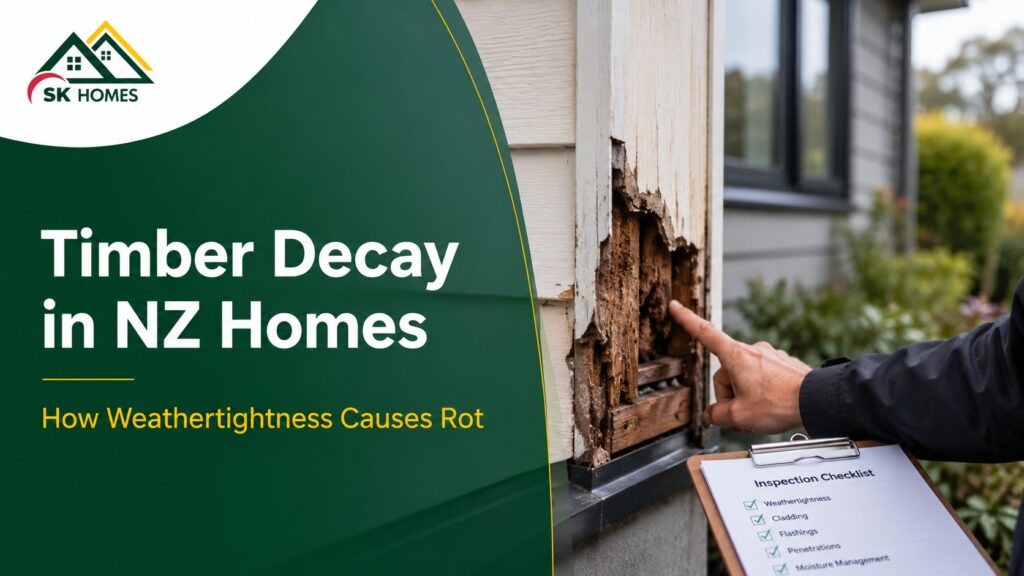
Timber Decay in NZ Homes: How Weathertightness Causes Rot
Timber decay in NZ homes is the most serious physical consequence of unresolved weathertightness failure, turning a moisture problem into a structural one.
Timber decay is the end result of the weathertightness failure chain in New Zealand homes. Water enters through failed cladding, inadequate flashings, or missing drainage cavities. The moisture content of the structural timber rises. Decay fungi establish and begin breaking down the timber’s cellulose structure. Over months and years, the timber loses strength and structural integrity. What began as a failed sealant joint or a missing flashing has become a structural problem that requires significant remediation.
Understanding how timber decay develops, how it is identified, and what it costs to remediate is essential knowledge for any NZ property buyer or homeowner dealing with weathertightness issues.
How Timber Decay Develops
New Zealand building timber – predominantly radiata pine in post-1950s construction – is susceptible to decay when its moisture content remains above approximately 20% for extended periods. At moisture contents below this threshold, even untreated timber resists decay effectively. Above 20%, and particularly above 25-30%, conditions favour the establishment of wood decay fungi.
Wood decay fungi are ubiquitous in the New Zealand environment – their spores are present in the air and on timber surfaces at all times. In dry timber, they are dormant. In continuously moist timber, they germinate, grow mycelium (fungal threads) through the timber, and begin consuming the lignin and cellulose that give the wood its strength. The visual result of this process is brown rot (which breaks down cellulose, leaving a brown cuboid cracking pattern in the timber) or white rot (which breaks down both cellulose and lignin, leaving a white fibrous material).
The Structural Consequence of Decay
Structural timber in NZ homes carries loads – from the roof, from upper floors, and from the building’s resistance to wind and earthquake forces. Timber that has lost structural integrity through decay cannot perform these functions adequately. The most significant structural risks from timber decay in weathertightness failures are:
- Window and door framing: The most commonly decayed elements in leaky buildings are the framing members around windows – the king studs, sill plates, and framing at window head level. This framing is also structural in many cases.
- Wall framing: Exterior wall studs in the moisture-affected zone lose section and strength. In severe cases, a wall stud may retain its original dimensions visually while having lost the majority of its structural capacity through internal decay.
- Bottom plates: The horizontal framing members at the base of walls sit in the area most exposed to moisture from failed cladding. Decay of bottom plates can affect the stability of the entire wall above.
- Floor joists and bearers: In homes with suspended timber floors, moisture ingress through the subfloor or from deck connections can cause decay of the floor structure.
- Roof framing: Where roof leaks have been present for extended periods, rafters, purlins, and top plates can be affected.
How Decay Is Identified During Inspection
During a pre-purchase building inspection, indicators of structural timber decay include:
- Soft, spongy, or crumbling material visible where framing is exposed (at damage, cut ends, or where wall linings have been removed)
- Discolouration – brown staining or whitening of timber surfaces
- Fruiting bodies (mushroom-like growths) of wood decay fungi on timber surfaces
- The characteristic cuboid cracking pattern of brown rot where wood has dried after decay
- A probe that penetrates more easily than expected into what should be solid framing
- Elevated moisture meter readings that indicate conditions favourable for decay
Importantly, in many cases timber decay behind monolithic cladding cannot be directly observed during a visual inspection. The cladding surface may appear sound while the framing behind it is significantly decayed. This is why moisture meter testing and, where indicated, invasive probe testing are essential components of a proper weathertightness investigation.
What Remediation Involves
Remediating timber decay requires:
- Opening the building envelope to access the affected framing
- Removing all decayed timber – decay cannot be treated in place; it must be removed
- Replacing decayed structural members with H1.2 or better treated timber
- Addressing the source of moisture – repairing or replacing the cladding, flashings, and drainage to prevent recurrence
- Allowing the building to dry thoroughly before reinstating wall linings
- Reinstating wall linings, cladding, and finishes
For properties with limited, localised decay, targeted repair may be feasible – opening only the affected wall sections, replacing the decayed framing, and reinstating the cladding in those areas. For properties with widespread decay affecting multiple elevations, full recladding with structural repairs is typically required.
Approximate Remediation Costs in NZ
- Targeted repair of a single window with localised decay: $8,000 to $20,000
- Targeted repair of a single elevation with moderate decay: $30,000 to $80,000
- Full recladding of a medium-sized (150-200sqm) Auckland home with structural repairs: $200,000 to $400,000
- Full recladding with severe structural decay requiring significant structural reconstruction: $350,000 to $600,000+
These are indicative ranges. Actual costs depend on the extent of damage found, access conditions, specification of replacement cladding, and contractor rates. Invasive investigation before purchase or before finalising a remediation scope is essential for understanding what the actual work will involve.
Frequently Asked Questions
Can timber with decay be treated rather than replaced?
No. Established timber decay cannot be treated in place to restore structural capacity. Decay fungi consume the structural components of the wood – this process cannot be reversed. Decayed timber must be removed and replaced with sound treated timber. Boron treatment can prevent future decay in at-risk timber and is applied to replacement framing, but it cannot address existing decay.
How quickly does timber decay progress?
The rate of decay depends on moisture levels, temperature, and the timber species. In warm, continuously wet conditions (Auckland in a monolithic cladding building with active water ingress), significant structural decay can develop within two to five years of moisture ingress starting. In drier conditions or colder climates, progression is slower. The key point is that once established, decay does not stop unless the moisture source is addressed.
What is treated timber and does it resist decay?
Treated timber has been impregnated with preservative chemicals (boron, copper-based preservatives, or others) that resist decay fungi and insect attack. Timber treatment classes in NZ range from H1.2 (interior dry situations) to H5 (in-ground contact). Modern framing timber for exterior walls and subfloor applications must meet appropriate treatment class requirements under the NZ Building Code. Many leaky building era homes were framed with untreated or inadequately treated timber, which accelerated the rate of decay when moisture was present.
If I buy a leaky building, can I claim against the previous owner?
This depends on the circumstances and requires legal advice. Where a vendor actively concealed a known defect, there may be grounds for a claim. In most cases, NZ’s caveat emptor (buyer beware) principles mean that buyers who did not carry out adequate pre-purchase investigation have limited legal recourse for defects discovered after purchase. This is the fundamental reason why specialist pre-purchase investigation is so important for high-risk properties.
Concerned about weathertightness? Book a professional Pre-Purchase Building Inspection with SK Homes NZ Limited. We identify weathertightness risks and moisture issues in Auckland, Hamilton, and Palmerston North properties. Contact us at info@skhomes.co.nz or visit skhomes.co.nz