
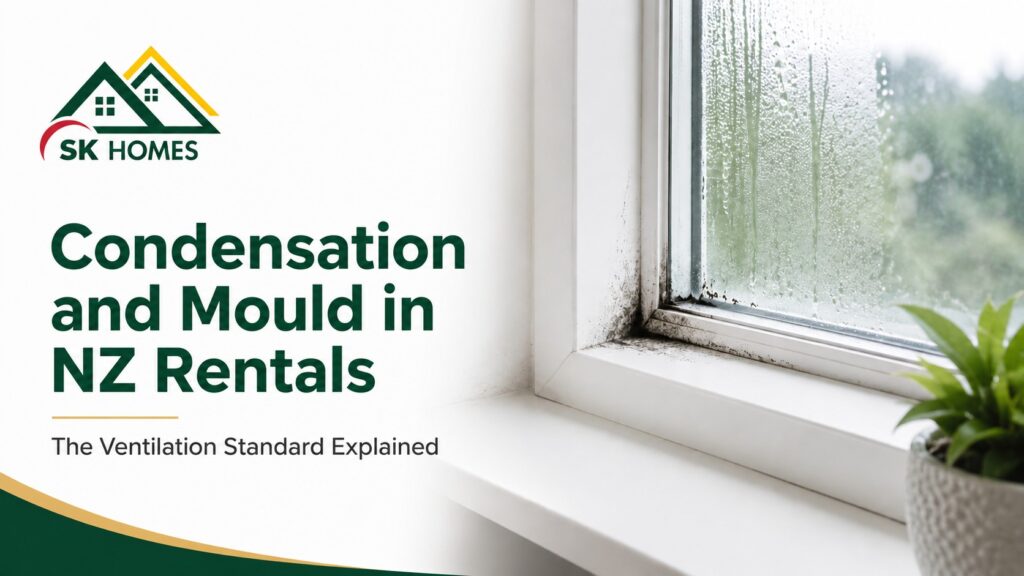
Condensation and Mould in NZ Rentals: Causes and Compliance Fix
Condensation and mould in NZ rentals are closely linked problems that the Healthy Homes Standards specifically address through ventilation and heating requirements.
Walk into almost any older Auckland rental in winter and the signs are there. Condensation on windows. Dark spots in corners of bedrooms. A musty smell in rooms with limited airflow. Mould on bathroom ceilings, on the walls around window frames, and sometimes spreading well beyond those areas. This is not a minor maintenance problem – it is a health issue and, in many cases, a Healthy Homes compliance failure.
Where Condensation Comes From
Condensation forms when warm, moist air contacts a cold surface. Inside a home, air becomes humid from cooking, showering, breathing, drying washing, and other normal activities. When that air meets a cold window, an uninsulated wall, or a cold floor, the moisture in the air condenses into liquid water on that surface.
In New Zealand’s older housing stock – particularly homes with single glazing, no ceiling insulation, and limited ventilation – this happens continuously through winter. The cold surfaces are everywhere: single-glazed windows, uninsulated exterior walls, cold bathroom tiles. Moisture builds up faster than it can escape, particularly where windows stay closed for warmth and ventilation is limited.
How Mould Takes Hold
Mould spores are present in every home. They become a problem when they have the conditions to germinate and grow: moisture, an organic surface to grow on, and temperatures above about 2 degrees Celsius. All three conditions are easily met in a damp, poorly ventilated New Zealand rental in winter.
Mould typically establishes first in areas with the highest moisture load: bathroom ceilings and walls, window sills and the adjacent wall, wardrobe interiors on exterior walls, and ceiling corners in bedrooms. Once established, mould grows progressively unless the moisture source is addressed. In severe cases in Auckland rentals, we have found mould covering entire walls of unheated bedrooms – not due to tenant negligence, but due to structural conditions that make moisture removal impossible without adequate ventilation and heating.
Health Effects of Mould in the Home
Mould in the home is not an aesthetic problem – it has real health consequences. Exposure to mould and its spores causes:
- Respiratory symptoms including coughing, wheezing, and shortness of breath
- Exacerbation of asthma – particularly in children
- Allergic reactions including sneezing, runny nose, and eye irritation
- In immunocompromised individuals, more serious respiratory infections
New Zealand has one of the highest rates of childhood asthma in the OECD. Research consistently links cold, damp housing to worse respiratory outcomes for children. The Healthy Homes Standards exist in large part to address this.
The Healthy Homes Ventilation Standard
The Ventilation Standard under the Residential Tenancies (Healthy Homes Standards) Regulations 2019 requires:
- Opening windows in every habitable room (bedroom, living room, dining room) – the openable area must be at least 5% of the floor area of the room
- An extractor fan in kitchens where a range hood with extraction to outside is not present
- An extractor fan in bathrooms that do not have an openable window
- Where an existing mechanical ventilation system is installed, it must be in good working order
The standard does not require heat recovery ventilation systems or whole-house mechanical ventilation – these are above the minimum. The minimum is openable windows of adequate size plus extractor fans in wet rooms where natural ventilation is absent.
What Assessors Check During the Ventilation Assessment
During a Healthy Homes assessment, SK Homes NZ checks all of the following for ventilation compliance:
- All habitable rooms have at least one openable window and the openable area meets the 5% of floor area requirement
- Windows are functional – not painted shut, not stuck, not broken
- Kitchen has a range hood that extracts to outside, or an extractor fan
- Bathrooms without openable windows have an extractor fan
- Where existing mechanical ventilation is present, it is operational and in good condition
Common Ventilation Compliance Failures in Older Rentals
The most frequent ventilation failures we find during assessments are:
- Bedroom windows that have been painted shut over successive repaints and no longer open
- Small fixed louvres in bathrooms that do not count as openable ventilation
- Kitchen range hoods that recirculate air rather than extracting it outside – these do not satisfy the ventilation standard
- Bathroom extractor fans that have failed, are clogged with dust, or were never wired correctly
- Bedrooms that were converted from other spaces (sunrooms, porches) without windows of adequate size
What Landlords Must Do
Where ventilation deficiencies are found, the remediation steps are typically straightforward and low cost compared to insulation or heating work:
- Painted-shut windows: broken free and repainted at the sash edges, or replaced if the frame is too damaged to repair. Budget $50 to $200 per window for freeing and repainting.
- Bathroom extractor fan: supply and install a standard bathroom fan typically costs $200 to $500 including electrician’s time.
- Kitchen extractor replacing a recirculating range hood: supply and install a ducted range hood runs $400 to $900 depending on duct run complexity.
Ventilation Alone Does Not Solve Mould
Better ventilation helps move moisture out of the home, but it does not address the cold surfaces that cause condensation in the first place. A bedroom with an openable window but no ceiling insulation, no heater, and single-glazed windows will still produce condensation when the window is closed in winter – which it will be on cold nights. Addressing mould effectively requires improving ventilation AND reducing the cold surfaces that cause condensation – which typically means insulation and heating improvements as well.
Frequently Asked Questions
Am I responsible as a landlord if my tenant does not open windows and mould develops?
Tenants do have a responsibility to ventilate the property and keep it reasonably clean. However, if the structural conditions of the property make mould inevitable regardless of tenant behaviour – because insulation is absent, heating is inadequate, or windows cannot open – the landlord carries primary responsibility. Blaming tenants for mould caused by structural deficiencies will not be accepted by the Tenancy Tribunal.
Does a recirculating range hood count as ventilation?
No. A recirculating range hood filters and returns air to the kitchen rather than extracting it outside. It does not satisfy the Ventilation Standard requirement. An extractor fan or range hood that vents to outside is required.
My bathroom has a skylight but no window and no fan. Is that compliant?
A fixed skylight without an opening panel does not count as an openable window for ventilation purposes. Where a bathroom has no openable window, an extractor fan is required regardless of skylights or other fixed glazing.
Do I need to install a whole-house ventilation system like HRV or DVS?
No. The Ventilation Standard does not require a whole-house mechanical ventilation system. Openable windows of adequate size plus extractor fans in wet rooms without natural ventilation is the minimum required. Whole-house systems are above and beyond the standard.
Book a professional Healthy Homes Assessment with SK Homes NZ Limited. We help landlords in Auckland, Hamilton, and Palmerston North achieve compliance with the Healthy Homes Standards.
📧 info@skhomes.co.nz | 🌐 skhomes.co.nz | 📞 029 045 0464
Related Articles
- Missing Insulation in NZ Homes
- Mould in NZ Rental Properties
- How to Prepare Your NZ Rental for a Healthy Homes Assessment
Condensation And Mould In NZ Rentals: Key Points for NZ Property Owners
Condensation and mould in NZ rentals are directly addressed by the ventilation and heating standards set by Tenancy Services NZ under the Residential Tenancies (Healthy Homes Standards) Regulations 2019. For more information, visit Tenancy Services NZ.