
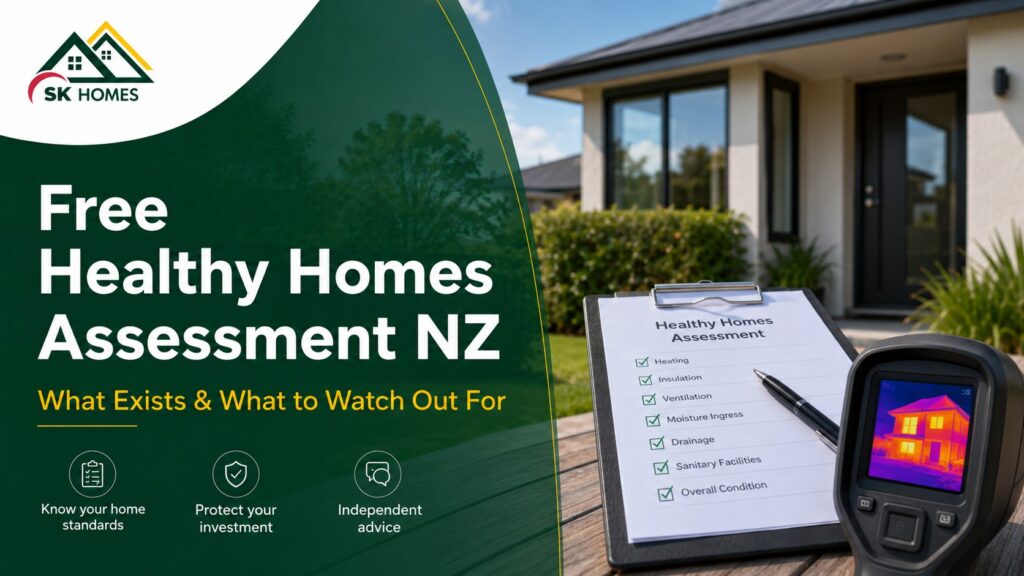
Free Healthy Homes Assessment NZ: What Actually Exists (And What to Watch Out For)
If you are a NZ landlord searching for a free Healthy Homes assessment, you are not alone. The question comes up regularly, and the honest answer is a little more nuanced than a simple yes or no. There are genuinely free resources available, but they come with real limitations. And some things marketed as “free assessments” are not quite what they appear to be.
This guide explains exactly what free Healthy Homes assessment options exist in New Zealand, what they cover, what they miss, and how to make a smart decision about your rental property compliance.
What Does a Healthy Homes Assessment Actually Involve?
Before looking at what is free and what is not, it helps to understand what a Healthy Homes assessment is meant to do. The purpose is to check whether a rental property meets all five Healthy Homes Standards under the Residential Tenancies (Healthy Homes Standards) Regulations 2019. The five standards are:
- Heating: A fixed heater in the main living area with sufficient capacity to heat the room to 18 degrees Celsius
- Insulation: Ceiling and underfloor insulation meeting the minimum R-value requirements
- Ventilation: Openable windows in habitable rooms and extractor fans in kitchens and bathrooms
- Moisture ingress and drainage: Efficient drainage, guttering, and a ground moisture barrier in enclosed subfloors
- Draught stopping: No unreasonable gaps or holes causing noticeable draughts
As of 1 July 2025, all private rental properties in New Zealand must comply with all five standards. Non-compliance can result in financial penalties of up to $7,200 per breach.
What Free Healthy Homes Options Actually Exist?
1. The Free MBIE Online Tools
Tenancy Services (MBIE) provides several free online tools that help landlords check specific parts of the Healthy Homes Standards:
- The Heating Assessment Tool at tenancy.govt.nz/heating-tool/ calculates the minimum heating capacity required for the main living area
- The Ventilation Tool at tenancy.govt.nz/healthy-homes/ventilation-standard/ventilation-tool/ helps check extractor fan requirements
- The Insulation Tool helps determine whether existing insulation meets the minimum standard
- The Compliance Timeframes Decision Tool helps work out when your property needed to comply
These tools are genuinely free and come directly from the government. They are a legitimate starting point.
However, they have significant limitations. The tools rely entirely on the accuracy of the information you enter. They only cover three of the five standards directly. They cannot physically inspect your property, check your subfloor for moisture, or identify draughts. And the outputs they produce are not the same as a comprehensive compliance report from a professional assessor.
2. Landlord Self-Assessment
There is no legal requirement in New Zealand for a landlord to hire a professional to conduct a Healthy Homes assessment. A landlord can self-assess their property against all five standards at no cost, using the MBIE tools and their own physical inspection of the property.
For a thorough self-assessment, a landlord would need to:
- Use the Heating Assessment Tool to calculate the required heating capacity and compare it against the installed heater’s rated output
- Measure all habitable rooms to check that openable windows meet the 1.22 percent floor area requirement
- Check kitchen and bathroom extractor fans meet the specifications
- Inspect ceiling insulation and underfloor insulation for type, depth, and R-value
- Inspect the subfloor for moisture and check that a ground moisture barrier is present
- Check gutters, downpipes, and drainage around the property
- Walk through every room checking for draughts around windows, doors, skirting boards, ceiling fixtures, and other penetrations
This is genuinely free if you do it yourself. The challenge is that it requires a good understanding of the specific technical requirements of each standard, access to the subfloor, and the time to do it thoroughly. If you miss something, you may still be non-compliant – and unaware of it until a tenant raises a dispute.
3. Free Assessments From Insulation Companies
Some insulation companies offer free Healthy Homes assessments, particularly to check whether existing insulation meets the standard. These are real and widely available.
However, there is an important conflict of interest to be aware of: insulation companies make money selling and installing insulation. An assessor working for an insulation company has a commercial incentive to find that your insulation needs upgrading, even if it is borderline or technically compliant. This does not mean free insulation assessments are always wrong or biased – but it is worth understanding the context in which the assessment is being offered.
Additionally, an insulation company’s free assessment will typically focus only on insulation. It will not cover heating, ventilation, moisture, draught stopping, or any of the other standards. It is a single-standard check, not a full Healthy Homes assessment.
4. Council and Community Programmes
Some local councils and community organisations run programmes that help eligible landlords or tenants access Healthy Homes support at reduced or no cost. These vary by region and availability changes over time. If you own a property in Auckland, Hamilton, Palmerston North, or another main centre, it is worth checking whether any current subsidised programmes apply to your situation.
These programmes are often targeted at lower-income tenants or specific property types rather than all landlords generally.
What Does a Paid Professional Assessment Actually Cost?
Professional Healthy Homes assessments in New Zealand typically cost between $200 and $600 for a standard residential property. The price varies depending on the size of the property, its location, and what is included in the report.
A professional assessment involves a qualified inspector visiting the property in person, checking all five standards, measuring rooms and checking specifications against the regulatory requirements, and producing a detailed written compliance report. That report can be used as evidence of compliance in your tenancy agreement compliance statement and provides documentation you can rely on if a dispute arises.
Compared to the potential penalty of up to $7,200 for non-compliance, the cost of a professional assessment is modest. It is also a legitimate business expense for landlords.
The Compliance Statement Requirement
One reason professional assessments have real value beyond a free self-check is the compliance statement requirement. Under the Residential Tenancies Act, all new or renewed tenancy agreements must include a signed statement about the property’s current level of compliance with the Healthy Homes Standards.
The compliance statement must be accurate. If you sign a statement saying your property complies when it does not, you are in breach of the Act – even if the inaccuracy was unintentional. Landlords who do not include the required compliance statement can face a financial penalty of up to $500 per tenancy.
A professional assessment provides documented evidence that the information in your compliance statement is accurate. A self-completed online calculator, while free, does not provide the same level of assurance.
Records Landlords Must Keep
Landlords must keep all records and documents showing how they are complying with the Healthy Homes Standards. These records must be made available on request – to tenants within 21 days, and to Tenancy Services if required.
A professional written assessment report is one of the most useful compliance records a landlord can keep. It documents the date of inspection, what was found, and what standard the property meets at that point in time. This is far more defensible than handwritten notes from a self-assessment or a printed webpage from an online tool.
So Is a Free Healthy Homes Assessment Enough?
It depends on what you use it for and how well you do it.
The free MBIE tools and a careful self-assessment can genuinely help you understand your property’s compliance position and identify what needs attention before spending money on a professional report. Many landlords find it worthwhile to use the free tools first, make any obvious upgrades, and then commission a professional assessment for the formal compliance record.
Where free options fall short is in providing documented, independent evidence of compliance across all five standards. If a tenant disputes your compliance at the Tenancy Tribunal, a written report from an independent professional assessor carries significantly more weight than a self-assessment or an online calculator printout.
For most landlords, the peace of mind that comes from a professional assessment, and the legal protection it provides, is worth the cost.
How SK Homes NZ Can Help
At SK Homes NZ, we offer professional, independent Healthy Homes assessments for landlords in Auckland, Hamilton, and Palmerston North. We cover all five Healthy Homes Standards in a single visit and produce a detailed written report that documents your property’s compliance position.
We are fully independent. We do not sell insulation, heaters, or any remediation products, so our assessments are never influenced by a commercial interest in the outcome. What we tell you is based solely on what we find at your property.
If you would like to know where your rental property stands and get a compliance record you can rely on, get in touch with our team.
Phone: +64 290 4504 642
Email: info@skhomes.co.nz
Website: skhomes.co.nz
Serving landlords in Auckland, Hamilton, and Palmerston North.