
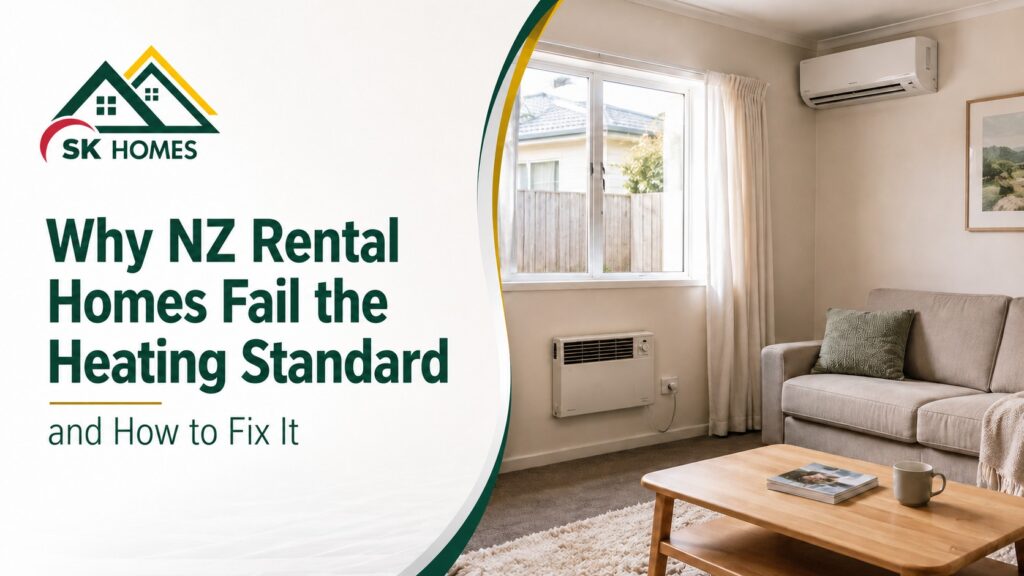
Why NZ Rental Homes Fail Heating Standard: Common Causes
Understanding why NZ rental homes fail the heating standard helps landlords identify the most common compliance gaps before a formal assessment.
The Healthy Homes Heating Standard is the most technical of the five Healthy Homes Standards and one of the most common areas of non-compliance. It requires landlords to provide a fixed heater in the main living room that can heat the space to at least 18 degrees Celsius. That sounds simple. In practice, calculating whether a heater is adequate – and understanding why so many older Auckland rentals fail this test – is more involved.
What the Standard Actually Requires
Under the Residential Tenancies (Healthy Homes Standards) Regulations 2019, landlords must provide a fixed heater capable of achieving and maintaining at least 18 degrees Celsius in the main living room of the property. The heater must be:
- Fixed to the floor, wall, or ceiling – portable heaters do not count
- Of a type that can be left unattended while operating (open fires and certain gas heaters with no flue that are prohibited under the standard do not qualify)
- Capable of the required heating output for the specific room – not just present in the room
How Heating Capacity is Calculated
Heating capacity is calculated using a formula set by the Ministry of Business, Innovation and Employment (MBIE). The formula takes into account:
- The floor area of the main living room in square metres
- The ceiling height
- The climate zone (Auckland, Hamilton, Palmerston North are in different zones with different design temperatures)
- The thermal performance of the building envelope – specifically the presence of insulation in the ceiling and floor, and the proportion of the room’s walls and windows that are glazed
The result is a required heating capacity in kilowatts (kW). The assessor then checks whether the installed heater meets or exceeds that capacity. If it does, the property complies. If the heater’s rated output is below the calculated requirement, it does not.
Why Older Properties So Often Fail
The building envelope performance of older NZ homes is typically poor. Single glazed windows, no ceiling insulation, no underfloor insulation, and high ceiling heights all increase the calculated heating requirement. At the same time, the heaters that were installed in these properties decades ago – gas wall heaters, open fires, small electric panel heaters – are often insufficient for the calculated requirement.
Consider a typical example: a 1970s Auckland villa with a 30 square metre living room, 2.7 metre ceilings, single glazed windows on three sides, and a 1.5kW electric panel heater. Run the MBIE formula and the required heating capacity might come back as 3.2kW or higher. The installed heater provides less than half the required capacity. This is non-compliant – and extremely common.
What Qualifies as a Compliant Heater
Heat pumps are by far the most common path to compliance in New Zealand. A heat pump provides a fixed, efficient, controllable heat source. For a typical three-bedroom Auckland rental, a 2.5kW to 3.5kW heat pump will often meet the calculated requirement – though the specific calculation must be done for the property. Heat pumps also provide cooling in summer, which tenants value.
Other qualifying fixed heaters include:
- Fixed electric panel heaters (must be of sufficient output)
- Flued gas heaters (where gas supply is present)
- Wood burners (must be capable of the required output)
- Ducted central heating systems
- Underfloor heating systems
Open fires do not qualify unless they have been assessed and found to meet the output requirement. Portable heaters of any type do not qualify.
The Impact of Insulation on Heating Compliance
The heating calculation is directly linked to the thermal performance of the building. Where insulation is absent, the required heating output is higher. This means a property with no ceiling or underfloor insulation may need a significantly larger heat pump to comply with the Heating Standard than the same property with full insulation installed.
This is why the Healthy Homes assessment looks at all five standards together. A property with adequate insulation may comply with the Heating Standard with a modest heat pump. The same property without insulation may require a much larger unit – or may need both insulation and a new heater to achieve compliance cost-effectively.
Cost of Installing a Compliant Heat Pump in Auckland
A standard single-head heat pump supplied and installed by a registered installer in Auckland typically costs $2,500 to $4,500 depending on the unit size, brand, and installation complexity. Units suitable for typical rental living rooms (2.5kW to 5kW) sit at the lower to mid end of that range. Where installation is complex – wall penetrations through masonry, long pipe runs, difficult outdoor unit placement – costs can be higher.
Heat pump installation must be carried out by a licensed electrician and a licensed refrigeration technician (or a contractor licensed in both trades). DIY installation is not legal.
What Happens if You Have Multiple Living Areas
The Heating Standard applies to the main living room only – not to bedrooms, hallways, or secondary living areas. However, the “main living room” is interpreted by assessors as the primary space where occupants gather – typically the largest or most central living area. Where a property has an open-plan kitchen and living area, the entire open-plan space may be considered the main living area for the purposes of the calculation.
Frequently Asked Questions
Does my rental need a heater in every room?
No. The Heating Standard requires a fixed heater in the main living room only. Bedrooms are not covered by the Heating Standard under the current regulations.
My property has a wood burner. Does that satisfy the standard?
A wood burner may satisfy the standard if its rated output is sufficient for the calculated requirement of the main living room. An assessor will check the rated output against the calculated requirement. If it meets the threshold, it qualifies.
My tenant has a portable heater. Does that count?
No. Portable heaters do not count toward the Heating Standard, regardless of their output. The heater must be fixed to the structure of the building.
Can I use the MBIE calculator myself?
MBIE provides a heating assessment tool online. You can use it to estimate your property’s requirement – but a professional Healthy Homes assessment provides a documented, defensible result and covers all five standards at once.
How much does a heat pump installation typically cost in Auckland?
Supply and installation of a standard single-head heat pump suitable for most rental living rooms runs $2,500 to $4,500 in Auckland. Get quotes from at least two registered installers.
Book a professional Healthy Homes Assessment with SK Homes NZ Limited. We help landlords in Auckland, Hamilton, and Palmerston North achieve compliance with the Healthy Homes Standards.
📧 info@skhomes.co.nz | 🌐 skhomes.co.nz | 📞 029 045 0464
Related Articles
- The Healthy Homes Standards NZ: A Complete Guide
- How to Prepare Your NZ Rental for a Healthy Homes Assessment
- The Real Cost of Healthy Homes Non-Compliance
NZ Rental Homes Fail Heating Standard: Key Points for NZ Property Owners
Understanding why NZ rental homes fail heating standard requirements begins with the fixed heater capacity rules published by Tenancy Services NZ, which specify minimum output based on room size and climate zone. For more information, visit Tenancy Services NZ.