
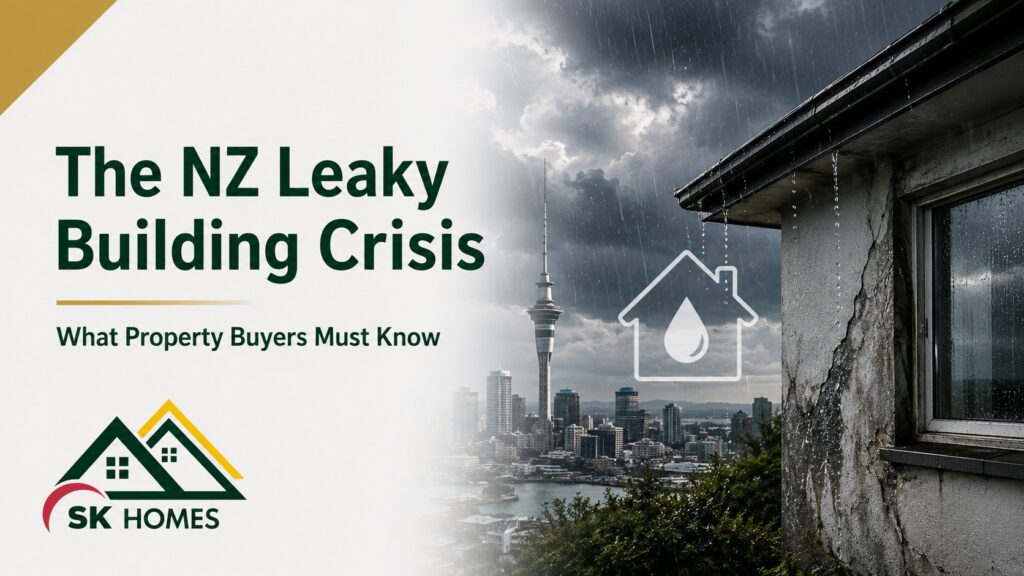
The NZ Leaky Building Crisis: What Property Buyers Must Know
The leaky building crisis is the largest building failure event in New Zealand history. Tens of thousands of homes built between approximately 1992 and 2004 were found to have catastrophic weathertightness failures – water entering wall cavities, destroying timber framing, and causing structural damage that in many cases made homes uninhabitable. The total cost of remediation has been estimated at $11 billion or more. Thousands of families lost significant portions of their life savings. Many properties remain partially remediated or unresolved today.
For property buyers in Auckland, Hamilton, and Palmerston North, understanding the leaky building crisis is not a matter of historical interest – it is essential due diligence. Affected properties continue to be bought and sold. Some have been fully remediated. Some have been partially fixed. Some have not been touched. And because the visible signs of weathertightness failure are often not apparent without specialist testing, buyers who do not carry out adequate pre-purchase investigation can purchase properties with significant concealed damage.
What Caused the Leaky Building Crisis
The crisis had multiple causes that converged in the late 1980s and 1990s. Understanding them helps property buyers identify the specific building types and features that carry the highest risk.
Monolithic Cladding Systems
The most significant factor was the widespread adoption of monolithic cladding systems – textured plaster, EIFS (Exterior Insulation and Finish Systems), and solid plaster applied to a timber-framed substrate. These systems had been used successfully in drier climates (Australia, the southern United States, Mediterranean countries) but were adopted in New Zealand without adequate adaptation for NZ’s high rainfall and humidity.
The critical failing was the absence of a drainage cavity between the cladding and the building’s waterproof membrane. In a correctly designed cladded wall, any water that penetrates the cladding can drain away through the cavity before it reaches the framing. In direct-fixed monolithic cladding (cladding applied directly to the framing with no cavity), any water that penetrated the outer surface was trapped against the framing. With nowhere to drain and with limited ability to dry, the trapped moisture caused progressive timber decay.
Inadequate Flashing Details
Flashings are the metal or membrane elements at roof-to-wall junctions, around windows and doors, and at penetrations that are designed to divert water away from vulnerable joints. During the leaky building era, flashing standards were often inadequate, flashings were poorly specified, and installation quality was inconsistent. Window flashings that did not extend adequately over the window frame, parapets without proper waterproofing, and deck connections without appropriate flashing details were extremely common.
Architectural Design Features
The architectural style popular in this era compounded the problem. Mediterranean, Spanish Mission, and contemporary architectural styles often featured: minimal or no eaves (which meant rain fell directly onto cladding joints rather than being thrown clear), complex rooflines with multiple valleys and intersections (more opportunities for flashing failure), parapet walls (which required waterproofing on their flat tops), and attached decks at first-floor level (a very high-risk junction point). Each of these features increases the weathertightness risk of a monolithic cladding building.
Building Code and Regulatory Failure
The Building Act 1991 and the Building Code that came with it introduced a performance-based regulatory approach. Under this approach, building consent authorities (local councils) assessed whether building designs met performance outcomes rather than specific technical prescriptions. This approach gave designers more flexibility but also allowed inadequate solutions to pass through the consent process without sufficient scrutiny. The Department of Building and Housing (now MBIE) and BRANZ conducted extensive research into the causes of the crisis following its identification in the late 1990s and early 2000s, and the findings informed the Building Act 2004 reform and improved NZ Building Code Clause E2 (External Moisture) provisions.
High-Risk Property Checklist
The following features significantly increase the weathertightness risk of a property. The more of these features present, the higher the risk:
- Built between 1992 and 2004
- Monolithic or plaster cladding with no visible cavity gap at the base of the wall
- No eaves or minimal eaves (less than 300mm)
- Complex roofline with multiple intersections, valleys, or changes in direction
- Parapet walls (solid walls above the roofline)
- Attached decks at first-floor level
- Multiple cladding types on the same building
- Mediterranean, Spanish Mission, or contemporary flat-roofed architectural style
- Located in a high-rainfall area (Auckland, West Coast, Manawatu)
- Skylights or other roof penetrations in flat or low-pitch roof sections
The Weathertight Homes Resolution Service
The Weathertight Homes Resolution Service (WHRS) was established by the Weathertight Homes Resolution Services Act 2006 to provide an alternative resolution pathway to the courts for homeowners with leaky building claims. The WHRS provided mediation and adjudication services for eligible claims. While the WHRS formal claim process has now closed to new claims, the legacy of its work – thousands of assessments of affected properties – provides significant documentation of the failure modes and affected building types.
Properties that were assessed under the WHRS have a documented weathertightness history. Buyers should check whether a property they are considering has any WHRS history via the property’s LIM report (Land Information Memorandum) from the local council. A LIM report is a standard due diligence step in any NZ property purchase and should be obtained before any offer goes unconditional.
What Property Buyers Must Do
For any property built between 1992 and 2004 with monolithic cladding, or any property displaying the high-risk features above, a standard pre-purchase building inspection to NZS 4306:2005 is necessary but may not be sufficient. NZS 4306 is a visual inspection standard – it identifies defects that are visible at the time of inspection. Concealed moisture damage behind monolithic cladding may not be visible without specialist moisture testing.
For high-risk properties, buyers should consider:
- A standard pre-purchase building inspection by an experienced inspector who understands weathertightness risk
- Moisture testing with calibrated moisture meters at windows, deck junctions, and other high-risk points
- For properties with significant risk indicators, a specialist weathertightness assessment may include invasive testing (opening sections of wall lining) to confirm the extent of any moisture damage
- Review of the LIM report for any WHRS history, building consents, or compliance issues
- Specific legal advice on disclosure obligations and any existing weathertightness claims
The Ongoing Legacy
The leaky building crisis is not a historical problem that has been resolved. Affected properties continue to exist in the NZ housing market. Some have been fully remediated with appropriate replacement cladding systems and structural repairs – these properties can be excellent value if the remediation was properly consented and carries LBP Records of Work. Some have been partially repaired. Some have not been touched and are still slowly deteriorating.
The key for buyers is information. A property with a known and documented weathertightness history that has been properly remediated is a manageable risk. A property with concealed weathertightness damage that has not been identified is a potentially devastating financial risk. Professional pre-purchase inspection and specialist weathertightness assessment are the tools that give buyers the information they need to make informed decisions.
Frequently Asked Questions
How do I know if a property is a leaky building?
The most reliable way is a professional pre-purchase building inspection with moisture testing. Visual indicators include the high-risk features listed above (monolithic cladding, no eaves, complex roofline), but moisture damage behind cladding is often invisible without specialist equipment. A LIM report will disclose any WHRS history or council compliance issues.
Are all monolithic cladding homes leaky buildings?
No. Not all monolithic cladding homes have weathertightness failures. Some were built with adequate detailing, some have cavity drainage systems, and some have been maintained so well that water ingress has not been significant. However, the risk is substantially higher for direct-fixed monolithic cladding homes built between 1992 and 2004, and these properties require more thorough investigation before purchase.
Does a vendor have to disclose a weathertightness problem?
Vendor disclosure obligations in NZ are limited compared to some other jurisdictions. Vendors generally must not actively mislead buyers, but there is no general legal obligation to proactively disclose defects. A LIM report will disclose known council records, but may not disclose privately-known weathertightness issues. Legal advice from a property solicitor is essential before any purchase of a suspected leaky property.
What does a remediated leaky building purchase involve?
A remediated property should have: building consents for the remediation work, LBP Records of Work for restricted building work, and ideally a post-remediation weathertightness report. Buyers should verify that consent was obtained, that the work was signed off by the council, and that the scope of work addressed all affected areas of the building.
How much does it cost to investigate a suspected leaky building?
A standard pre-purchase building inspection with moisture testing from SK Homes NZ starts from $450 + GST. A specialist weathertightness investigation with invasive testing (opening wall sections) typically costs $1,500 to $5,000 depending on the scope. These costs are very small compared to the potential remediation cost of an undetected leaky building.
What is NZ Building Code Clause E2 and why does it matter?
Clause E2 (External Moisture) of the NZ Building Code sets the performance requirements for buildings to resist moisture entry from rain, ground water, and surface water. The Acceptable Solutions for Clause E2 (E2/AS1) were significantly revised after the leaky building crisis to require drainage cavities, improved flashing details, and better documentation of weathertightness-critical elements.
Can I get insurance for a leaky building?
Standard NZ home insurance policies exclude gradual damage and pre-existing defects. Many insurers are cautious about insuring known leaky buildings or high-risk monolithic cladding properties, and may decline cover, add exclusions, or charge higher premiums. Check your insurance position carefully before purchasing a high-risk property.
Is the leaky building crisis only in Auckland?
No, though Auckland has the highest concentration of affected properties due to its large population, high rainfall, and the prevalence of the building type in Auckland’s 1990s-2000s suburban development. Affected properties exist across all NZ regions including Hamilton and Palmerston North, though the risk is highest in high-rainfall areas.
Do I need a specialist weathertightness report or is a standard inspection enough?
For low-risk properties (pre-1990s construction, timber weatherboard cladding, adequate eaves), a standard pre-purchase inspection is usually adequate. For high-risk properties (1992-2004, monolithic cladding, multiple risk factors), a specialist weathertightness assessment with moisture testing is strongly recommended. SK Homes NZ can advise on the appropriate level of investigation after an initial assessment.
What happens if I discover my purchased home is a leaky building?
Your options depend on the circumstances. If the vendor actively concealed a known defect, you may have legal remedies. If the discovery was through your own investigation post-purchase, your options are more limited. Seek legal advice from a property lawyer immediately. Contact your insurer. Get a full weathertightness investigation and remediation quote so you understand the scope of the problem. Early professional engagement is essential.
Concerned about weathertightness? Book a professional Pre-Purchase Building Inspection with SK Homes NZ Limited. We identify weathertightness risks and moisture issues in Auckland, Hamilton, and Palmerston North properties. Contact us at info@skhomes.co.nz or visit skhomes.co.nz