
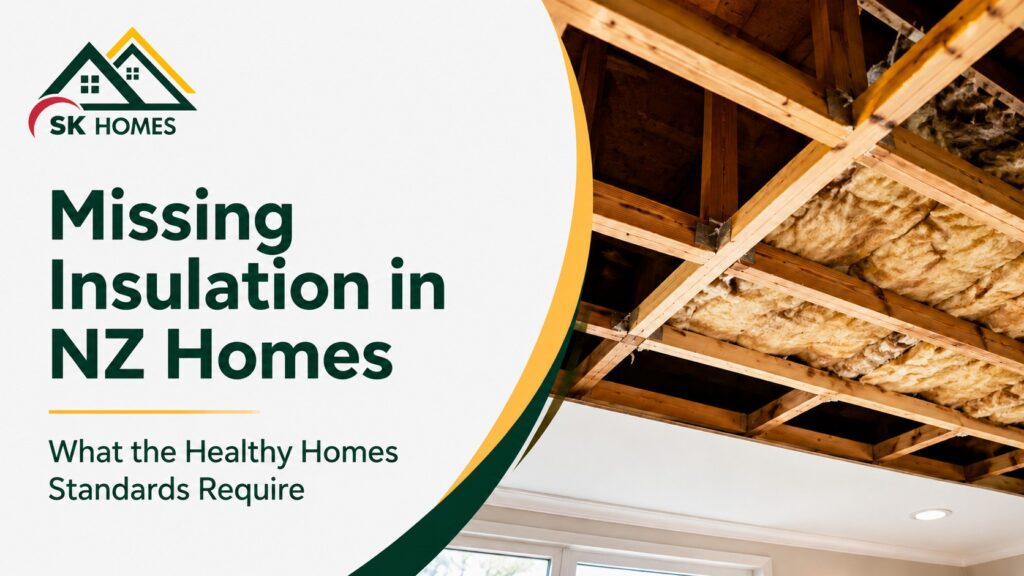
Missing Insulation in NZ Homes: Healthy Homes Standards Guide
Missing insulation in NZ homes is one of the most common findings during healthy homes assessments, particularly in rental properties built before 1978.
New Zealand has some of the worst residential insulation rates in the developed world. Older homes built before the 1970s – and many built through the 1980s – were constructed with little or no insulation. Where insulation was installed, decades of settlement, moisture damage, pest activity, and building work have often left it degraded, compressed, or missing entirely. For landlords, this is one of the most common reasons a Healthy Homes assessment returns a non-compliance finding.
What the Insulation Standard Requires
The Healthy Homes Insulation Standard is set out in the Residential Tenancies (Healthy Homes Standards) Regulations 2019. It requires ceiling and underfloor insulation where it is reasonably practicable to install or top up existing insulation. The specific R-value requirements depend on the climate zone the property is in:
- Auckland (Climate Zone 1): Ceiling insulation must achieve R-value of 2.9 or higher. Underfloor insulation must achieve R-value of 1.3 or higher.
- Hamilton (Climate Zone 2): Ceiling insulation must achieve R-value of 3.3 or higher. Underfloor insulation must achieve R-value of 1.3 or higher.
- Palmerston North (Climate Zone 3): Ceiling insulation must achieve R-value of 3.3 or higher. Underfloor insulation must achieve R-value of 1.3 or higher.
Where insulation is already present but does not meet the required R-value, landlords must top it up to reach the standard. Existing insulation that already meets the minimum R-value and is in reasonable condition does not need to be replaced.
What Assessors Find in Older NZ Properties
During Healthy Homes assessments at SK Homes NZ, the most common insulation issues we find in properties built before 1990 are:
- No ceiling insulation – common in pre-1970 homes where insulation was not standard practice
- Fibreglass batts that have settled and compressed over time, reducing their effective R-value significantly below the labelled rating
- Wet or moisture-damaged insulation – where roof leaks, condensation, or subfloor moisture have affected the material
- Insulation that has been disturbed or removed during electrical, plumbing, or roof work and not reinstated
- No underfloor insulation – extremely common in homes with suspended timber floors where the subfloor space was not insulated at construction
- Foil underfloor insulation – permitted as existing insulation if in good condition but not accepted as a top-up path under the current standard
- Insulation present in ceiling but absent in accessible roof areas such as flat sections or skillion roofs
The “Reasonably Practicable” Test
The insulation standard does not require landlords to install insulation in every possible situation. Where installation is not “reasonably practicable” – for example where the ceiling space is inaccessible, where there is insufficient clearance under the floor for safe installation, or where structural issues make installation impossible – the standard does not require it.
However, the reasonably practicable threshold is applied strictly. The fact that installation is inconvenient, or that access requires some work, is not sufficient grounds for an exemption. The assessor will look at actual access conditions and document the specific reasons why installation is not practicable where this applies.
Ceiling Insulation – What to Check
To check your ceiling insulation, access the ceiling space via the ceiling hatch and measure the depth of the insulation. The relationship between depth and R-value depends on the type of insulation material:
- Glass wool batts: R-value is typically marked on the batt wrapper. At 100mm depth, expect approximately R1.8. At 150mm, approximately R2.6. At 200mm, approximately R3.2.
- Polyester batts: Similar performance to glass wool at equivalent depths
- Blown cellulose or glass fibre: R-value depends on depth and density – a certified assessor can calculate this from measurements
Where existing insulation is present but below the required R-value, adding additional insulation on top is the standard approach. Where no insulation is present, new batts or blown insulation can be installed from above via the ceiling access.
Underfloor Insulation – What to Check
Underfloor insulation in New Zealand is predominantly polyester or glass wool batts fitted between floor joists, or foil. To check your underfloor insulation you need access to the subfloor space – via an access hatch, usually located outside at the perimeter of the foundation. Inside the subfloor space you should be able to see whether insulation is present between the joists, what condition it is in, and whether it is secure and not sagging away from the floor above.
Common problems found under older Auckland properties include:
- Batts sagging or falling away from the floor due to failed or absent fasteners
- Batts wet or discoloured from subfloor moisture – wet insulation has a fraction of its rated R-value and can harbour mould
- Foil insulation that has torn, corroded, or pulled away from the joist
- No insulation at all in the subfloor space
What Insulation Installation Costs in NZ
Ceiling insulation installation costs for a typical three-bedroom home in Auckland run approximately:
- Ceiling only (top-up): $600 to $1,200 depending on existing insulation and access
- Ceiling only (new install): $1,200 to $2,500 for a three-bedroom home
- Underfloor only (new install): $1,500 to $3,000 for a three-bedroom home depending on access and ground conditions
- Ceiling and underfloor combined: $3,000 to $5,500 for a typical Auckland three-bedroom rental
Prices vary significantly based on the property’s accessibility, the installer, and whether preparation work (subfloor clearing, access improvements) is required. Get at least two quotes from certified installers.
Frequently Asked Questions
My property already has insulation but it looks old and compressed. Does it need replacing?
Not necessarily. If the existing insulation is in reasonable condition (not wet, not significantly disturbed) and still meets the minimum R-value after accounting for compression and settlement, it can remain. A Healthy Homes assessor can assess the effective R-value and advise whether top-up is required.
Is foil insulation acceptable under the Healthy Homes Standards?
Foil underfloor insulation is accepted as existing insulation if it was installed correctly and is in good condition. However, it cannot be used as a top-up pathway to reach the required R-value under the current standard. If foil is present but the R-value target is not met, the usual path is to install batts alongside or in addition to the foil.
What if my ceiling space is too tight to access?
Where the ceiling space genuinely cannot be accessed safely for installation, the landlord may be exempt from the ceiling insulation requirement for that area. Blown insulation can sometimes be installed in tight spaces where batt installation is not possible – an insulation installer should assess the specific conditions.
Does wall insulation need to comply with the Healthy Homes Standards?
The Healthy Homes Insulation Standard covers ceiling and underfloor insulation only. Wall insulation is not required by the current standard. However, wall insulation significantly improves thermal performance and reduces heating loads.
Book a professional Healthy Homes Assessment with SK Homes NZ Limited. We help landlords in Auckland, Hamilton, and Palmerston North achieve compliance with the Healthy Homes Standards.
📧 info@skhomes.co.nz | 🌐 skhomes.co.nz | 📞 029 045 0464
Related Articles
- The Healthy Homes Standards NZ: A Complete Guide
- Subfloor Moisture in NZ Rentals
- How to Prepare Your NZ Rental for a Healthy Homes Assessment
Missing Insulation In NZ Homes: Key Points for NZ Property Owners
Missing insulation in NZ homes is one of the most commonly cited compliance failures in assessments, and Tenancy Services NZ specifies the minimum R-values required for ceiling and underfloor insulation in each climate zone. For more information, visit Tenancy Services NZ.