
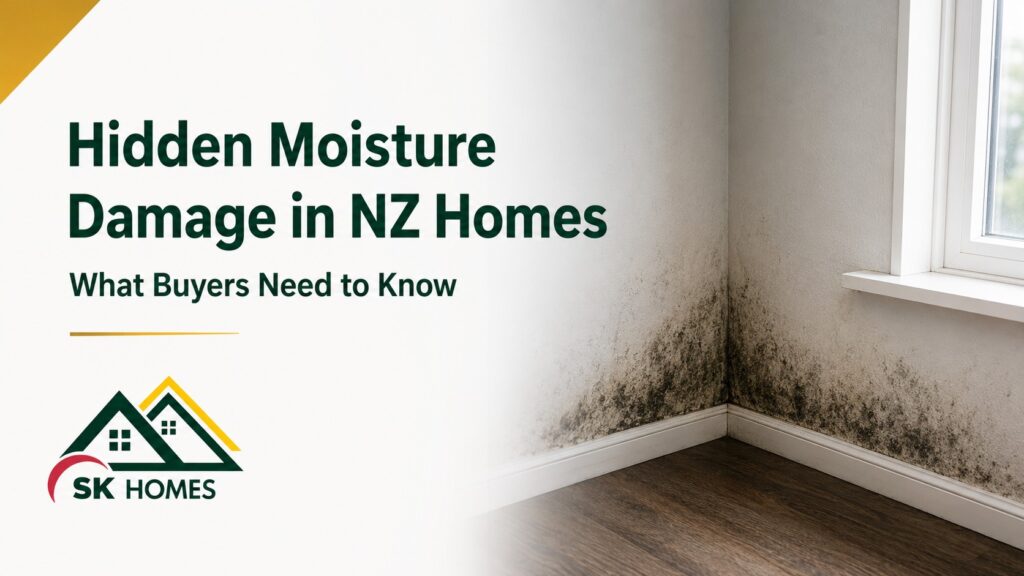
Hidden Moisture Damage in NZ Homes: What Buyers Need to Know
Hidden moisture damage in NZ homes represents the most expensive category of building defect, precisely because it cannot be seen during a casual inspection.
The most expensive building defects in New Zealand are the ones you cannot see. Structural timber rot behind a seamless plaster surface. Wet insulation above a ceiling that looks perfectly fine. Decaying floor joists beneath a floor that feels solid underfoot. These are the hidden moisture damage scenarios that have cost NZ property buyers millions of dollars collectively – money spent on remediation after purchase that a professional pre-purchase inspection with moisture testing would have identified before the property was bought.
Why Moisture Damage Hides
Moisture damage in a building does not always produce visible symptoms – at least not immediately. Consider what happens when water enters the wall cavity of a monolithic cladding building at a failed window flashing. The water contacts the timber framing inside the wall. If the framing is untreated timber, it begins to absorb the moisture. Over weeks and months, the moisture content of the timber increases. Fungal spores present in the environment germinate and begin to colonise the moist timber surface. Decay begins to progress.
None of this is visible from inside or outside the building. The plaster cladding surface shows no change. The interior wall lining is undamaged. The only evidence – at this stage – is a slightly elevated moisture meter reading if a probe is held against the interior wall surface, or an elevated reading at the exterior where the moisture is migrating through the cladding system.
The symptoms become visible much later – when the decay has progressed sufficiently that the wall lining distorts or discolours, or when water has begun to enter the interior space. By the time visible symptoms appear, the damage may have been developing for years and have become structurally significant.
The Tools That Find Hidden Moisture
Moisture Meters
A calibrated moisture meter is the standard tool for detecting concealed moisture in building materials. Two types are used in building inspection:
- Pin-type meters: Two metal pins are pressed into the surface of a material. The meter measures electrical resistance between the pins, which correlates to moisture content. Pin meters provide readings directly in the material being tested. They are accurate but create small marks on the surface.
- Capacitance meters (non-invasive): A flat plate sensor is pressed against the surface. The meter measures the electromagnetic properties of the material behind the surface, which are affected by moisture. Capacitance meters can detect moisture behind wall linings and cladding surfaces without penetration. They indicate whether further investigation is warranted but are less precise than pin meters in quantifying moisture content.
During a pre-purchase building inspection, SK Homes NZ uses moisture meters at all high-risk locations – window perimeters, base of cladding, deck junctions, parapet junctions, and any location where the visual assessment suggests elevated risk. Elevated readings trigger recommendations for further specialist investigation.
Thermal Imaging
Thermal imaging (infrared) cameras detect temperature differences in building surfaces. Moisture in a building material causes a temperature difference compared to dry material – wet areas appear cooler on a thermal image because moisture has higher thermal mass. Thermal imaging can identify moisture patterns in wall assemblies, ceiling cavities, and floor structures that are not visible to the naked eye.
Thermal imaging is most effective in the right conditions – a temperature differential between inside and outside the building of at least 10 degrees Celsius. In Auckland’s mild climate, the window for effective thermal imaging is limited but available in winter months.
Invasive Probe Testing
For properties where non-invasive moisture testing indicates elevated readings but cannot confirm the extent of damage, invasive probe testing provides more definitive information. Small diameter holes (typically 6-12mm) are drilled through the cladding surface at selected locations and a probe moisture meter is inserted to take readings directly in the framing timber behind the cladding. This provides direct measurement of framing moisture content.
Probe testing requires vendor permission (typically negotiated as a condition of the sale agreement). The holes are filled before the inspection is complete. Probe results are highly diagnostic – readings above 20% in framing timber confirm active risk conditions, and readings above 25-30% confirm that decay is likely occurring or has occurred.
The Financial Case for Specialist Investigation
The cost of a specialist weathertightness investigation with moisture testing typically ranges from $1,500 to $5,000 for a medium-sized NZ residential property. This seems like a significant additional cost on top of the standard building inspection. In the context of what it might prevent, however, it is one of the best-value expenditures available to a property buyer.
Consider the cost comparison:
- Targeted repair of limited moisture damage found early: $5,000 to $30,000
- Partial recladding of significantly affected section: $30,000 to $80,000
- Full recladding of a medium-sized Auckland home: $150,000 to $350,000
- Full recladding plus structural repairs on a severely affected property: $300,000 to $600,000+
A $3,000 specialist investigation that identifies $200,000 of concealed remediation work before purchase saves that $200,000 – either through a renegotiated price, a decision not to purchase, or knowledge that allows the buyer to appropriately provision for the remediation cost.
What the Inspection Report Should Tell You
A good pre-purchase inspection report on a potential weathertightness property should include:
- Clear identification of the building type and weathertightness risk profile
- Moisture meter readings at each tested location with an interpretation of what the readings indicate
- A statement on whether further specialist investigation is recommended and why
- Any visible defects identified at high-risk locations
- The inspector’s overall assessment of weathertightness risk for the property
Frequently Asked Questions
Can moisture damage behind cladding be fixed without full recladding?
Where damage is limited in extent and the surrounding structure is sound, targeted repair (opening the affected section, replacing damaged framing, reinstating cladding in the affected area) is possible and is significantly cheaper than full recladding. The feasibility of targeted repair versus full recladding can only be determined by invasive investigation to understand the full extent of the damage.
My building inspection report says moisture readings are slightly elevated. Should I be concerned?
It depends on the level, the location, and the building type. Slightly elevated readings in a low-risk property in wet weather may be consistent with surface moisture rather than framing moisture. Elevated readings at multiple points around windows in a monolithic cladding home are more concerning. Your inspector should provide context for the readings – if the report does not explain what the readings mean, ask the inspector directly.
How do I negotiate price based on weathertightness risk?
The most effective approach is to obtain a specialist weathertightness investigation (with vendor permission as a condition of the agreement) and use the findings – including remediation cost estimates from qualified contractors – as the basis for price renegotiation. Established weathertightness issues provide a documented basis for a price reduction that is much stronger than a general concern expressed without supporting evidence.
Is hidden moisture damage covered by my home insurance?
Generally no. NZ home insurance policies exclude gradual deterioration, pre-existing defects, and damage caused by construction faults. Moisture damage that has developed over years due to a weathertightness failure is typically excluded as a pre-existing defect or gradual damage. This is why pre-purchase investigation is so important – once you own the property, the remediation cost is yours to bear.
Concerned about weathertightness? Book a professional Pre-Purchase Building Inspection with SK Homes NZ Limited. We identify weathertightness risks and moisture issues in Auckland, Hamilton, and Palmerston North properties. Contact us at info@skhomes.co.nz or visit skhomes.co.nz