
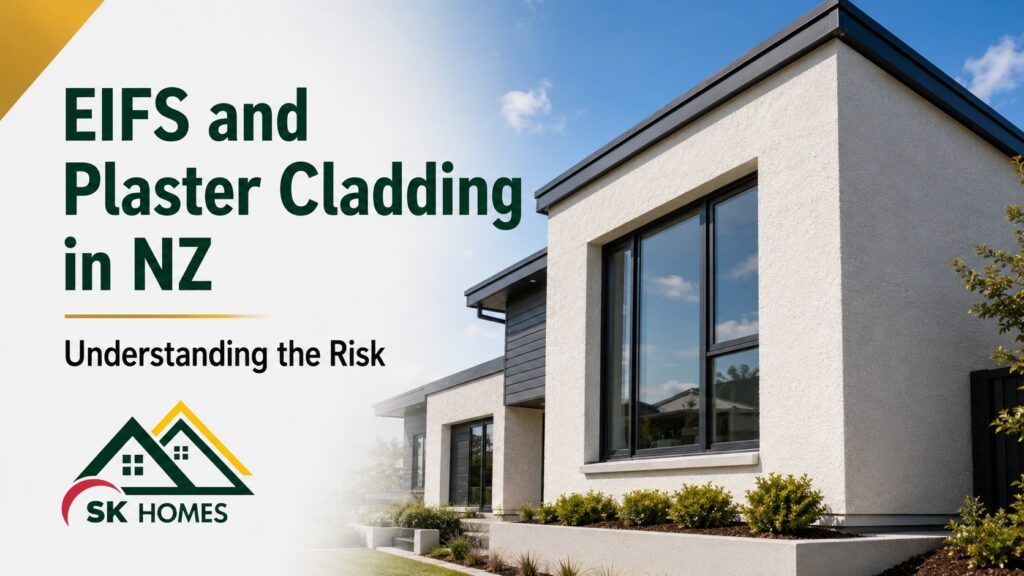
EIFS and Plaster Cladding in NZ: Understanding the Risk
EIFS and plaster cladding in NZ are the cladding systems most closely associated with the leaky building crisis of the 1990s and early 2000s.
EIFS – Exterior Insulation and Finish Systems – and solid plaster cladding are the cladding types at the centre of New Zealand’s leaky building crisis. More complaints were brought about these systems than any other building type in the Weathertight Homes Resolution Service. More remediation work has been carried out on these properties than any other category. And yet, decades after the crisis was identified, EIFS and plaster cladding homes continue to be bought and sold in the Auckland, Hamilton, and Palmerston North markets – sometimes by buyers who do not fully understand the risk they are taking on.
This article explains what EIFS and plaster cladding are, why they fail, and what investigation is required before purchasing a property with these systems.
What Is EIFS
EIFS stands for Exterior Insulation and Finish System. It is a proprietary composite cladding system consisting of:
- An insulating board (typically expanded polystyrene, 25-100mm thick) adhered to the building framing or sheathing
- A reinforced base coat applied over the insulation (embedded fibreglass mesh provides reinforcement)
- A textured or smooth finish coat – typically acrylic-based – applied as the final exterior surface
EIFS was promoted in NZ from the late 1980s as a solution that combined insulation and cladding in a single system. Brand names commonly found in the NZ market include Rockcote, Sto, Dryvit, and Parex. The appearance is typically a smooth or fine-aggregate textured surface, often with architectural banding, reveals, or geometric details that were popular in the Mediterranean and contemporary architectural styles of the era.
What Is Solid Plaster Cladding
Solid plaster (or stucco) cladding predates EIFS and has been used in NZ construction for many decades. Traditional solid plaster consists of cement-based plaster coats applied over a wire-reinforced substrate – originally applied directly to timber lath, and in more recent construction applied over fibre cement sheet or metal lath. Solid plaster is heavier than EIFS and has a different acoustic quality when tapped – a dull thud compared to the slightly hollow sound of EIFS over polystyrene.
From a weathertightness risk perspective, direct-fixed solid plaster shares many of the same failure characteristics as direct-fixed EIFS: any water that penetrates the outer surface has no drainage path away from the framing.
Why These Systems Fail in NZ
No Drainage Cavity
The fundamental failure mode is the absence of a drainage cavity. In the buildings most affected by the leaky building crisis, the EIFS or plaster was applied directly to the timber framing or sheathing with no gap between the back of the cladding system and the building’s weather-resistant barrier (building wrap or building paper). Water that penetrated the outer surface – through cracks, failed sealants, or inadequate flashings – had no drainage path. It accumulated in the wall assembly and raised the moisture content of the framing.
Lack of Drying Ability
Even where water penetration was minor, the inability of the wall assembly to dry out meant that moisture accumulated over time. EIFS in particular acts as a moisture trap – the polystyrene insulation layer holds any moisture that gets behind it against the framing. In a well-ventilated cavity wall, moisture that enters can dry out. In a direct-fixed EIFS wall, it cannot.
Poor Joint and Flashing Details
The EIFS systems installed in NZ during the leaky building era often had inadequate flashing and joint details. Window flashings that terminated on the face of the EIFS rather than extending behind it. Sealant joints at window perimeters that were the only line of defence against water entry. Roof-to-wall junctions that relied on sealant alone rather than properly lapped and integrated flashings.
How EIFS and Plaster Cladding Failures Are Identified
During a pre-purchase building inspection, an experienced inspector assesses EIFS and plaster cladding properties for:
- Cracking in the cladding surface – particularly at window and door corners (stress concentrations), control joints, and changes in plane
- Condition and integrity of all sealant joints
- Evidence of moisture tracking – staining, discolouration, efflorescence (white salt deposits) on the cladding surface
- Moisture meter readings at window perimeters, base of walls, deck junctions, and other high-risk locations
- Interior symptoms – wall lining staining, skirting board swelling, mould at window reveals
- Base of wall detail – how the cladding terminates at the foundation line
Where moisture readings are elevated, or where visible cracking or failed sealants are found at multiple locations, the inspection report should recommend specialist weathertightness investigation before proceeding with purchase.
Cavity vs Direct-Fixed EIFS
Not all EIFS properties are equally high-risk. Following the leaky building crisis and the Building Code reforms of 2004, EIFS manufacturers developed cavity systems – versions of their products that incorporate a drainage gap between the insulation board and the building’s weather-resistant barrier. Cavity EIFS has significantly lower risk because water that penetrates the outer surface can drain away through the cavity.
The difficulty for buyers is that cavity and direct-fixed EIFS can look identical from the exterior. Determining whether a cavity is present requires inspection of the cladding termination details at the base of the wall or at penetrations, review of the building consent documents, or in some cases cutting a small inspection hole.
Insurance for EIFS Properties
Insurance companies in NZ are aware of the weathertightness risk profile of EIFS and direct-fixed monolithic cladding properties. Some insurers will decline to insure these properties, particularly those built between 1992 and 2004 with direct-fixed cladding. Others will insure but with exclusions for weathertightness damage. Buyers must check insurance availability and any exclusions before going unconditional on an EIFS property – the inability to obtain insurance at a reasonable premium is a significant factor in the risk assessment of any purchase.
Frequently Asked Questions
How do I tell EIFS from solid plaster?
Tap the wall surface gently. EIFS over polystyrene gives a slightly hollow sound and slight flex under pressure. Solid plaster is harder and gives a duller sound with no flex. EIFS cladding is also typically lighter weight – look at how the base of the cladding terminates and any visible cross-sections at damage points. A building inspector can usually determine the cladding type during inspection.
My property has EIFS but was built in 2008. Is it still high-risk?
Post-2005 EIFS properties built to the revised Acceptable Solutions for Building Code Clause E2 are typically lower-risk because they should have cavity drainage systems. However, a pre-purchase inspection with moisture testing is still recommended. The Building Code reforms improved the minimum standard but did not eliminate the possibility of construction defects or inadequate detailing.
Can EIFS cladding be repaired or does it need full replacement?
Where weathertightness failure and timber decay are limited in extent, targeted repair (removing affected sections, replacing damaged framing, re-cladding the affected area) may be an option. Where damage is widespread, full recladding is typically the appropriate solution. The extent of damage – and therefore the appropriate remediation approach – can only be determined by invasive investigation.
Should I avoid buying EIFS properties entirely?
Not necessarily. Many EIFS properties are well-maintained, have been inspected and found to be weathertight, or have been properly remediated. The key is information. An EIFS property with a clean specialist weathertightness report and no elevated moisture readings is a different proposition from an uninvestigated EIFS property with multiple risk factors. Do not avoid the property type blanket – investigate it properly.
Concerned about weathertightness? Book a professional Pre-Purchase Building Inspection with SK Homes NZ Limited. We identify weathertightness risks and moisture issues in Auckland, Hamilton, and Palmerston North properties. Contact us at info@skhomes.co.nz or visit skhomes.co.nz