
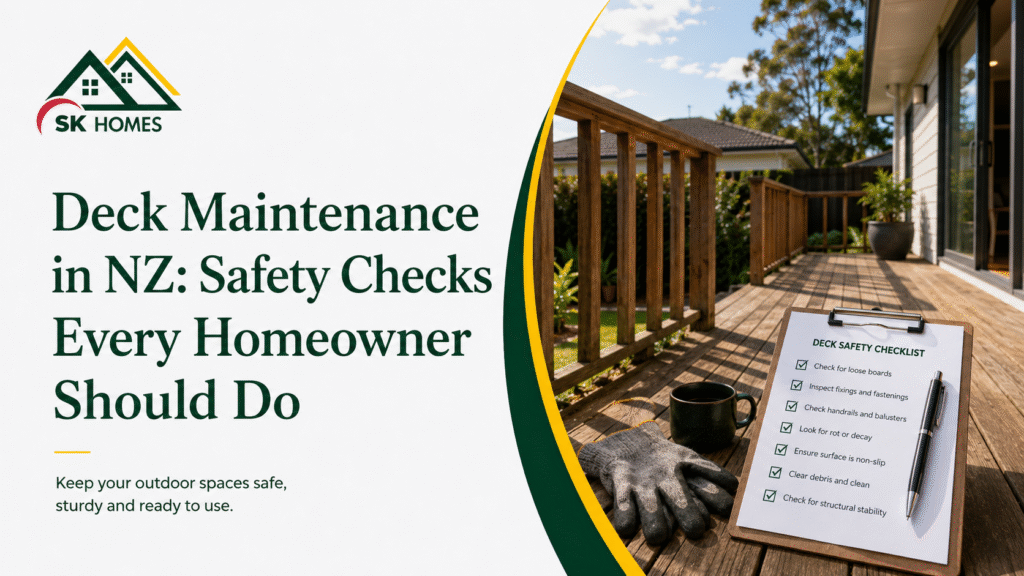
Deck Maintenance in NZ: Safety Checks Every Homeowner Should Do
Deck maintenance in NZ is critical for safety, not just appearance. A poorly maintained deck can deteriorate in ways that are not always obvious to the eye, creating a genuine safety hazard for homeowners and visitors. This guide covers the key deck maintenance checks every NZ homeowner should carry out regularly, along with the warning signs that indicate professional attention is needed.
Why Deck Maintenance in NZ Matters for Safety
New Zealand’s climate, with significant rainfall and UV exposure, places considerable stress on timber decking. Without regular maintenance, structural elements such as joists, bearers, and connections can deteriorate well before any visible surface damage appears. BRANZ has published guidance highlighting deck failures as a recurring cause of injury in residential settings, often linked to deferred maintenance rather than poor original construction. See branz.co.nz for further detail on deck construction and maintenance standards.
Annual Deck Maintenance Checklist for NZ Homeowners
1. Check for Loose or Wobbly Balustrades
Test handrails and balustrades by applying firm pressure. Any movement or looseness indicates the fixings need attention before the balustrade fails under load.
2. Inspect Deck Boards for Rot or Decay
Press a screwdriver gently into suspect areas of decking, particularly near joints and where water tends to pool. Soft or crumbling timber indicates decay requiring board replacement.
3. Check Under-Deck Framing and Connections
Where access allows, inspect joists, bearers, and the connections between them. Rust on metal fixings, or visible gaps where framing has pulled away from connections, are warning signs.
4. Look for Signs of Moisture Trapped Against the House
Decks attached to the house can trap moisture against cladding if flashing details are inadequate. Check for staining or deterioration on the house wall where the deck connects.
5. Check Stair Treads and Stringers
Deck stairs experience concentrated foot traffic and should be checked for the same decay and connection issues as the main deck structure.
6. Reapply Protective Coatings
Oiling or staining timber decking every one to two years helps protect against moisture absorption and UV damage, extending the life of the timber significantly.
7. Check Deck Footings and Posts
Where visible, check support posts for rot at ground level and confirm footings remain stable with no visible movement or settling.
Warning Signs That Mean You Need Professional Help
- Visible springiness or bounce when walking across the deck
- Any movement in balustrades or handrails
- Soft, crumbling, or hollow-sounding timber when tapped
- Rust or corrosion on structural fixings
- Gaps between framing members that were not present previously
- A deck that is more than 15 to 20 years old without significant maintenance history
How Often Should You Inspect Your Deck?
A visual check should be done at least once a year, ideally before summer when decks see the most use. A more thorough inspection, including checking under-deck framing where accessible, is recommended every two to three years, or sooner if you notice any warning signs.
Frequently Asked Questions: Deck Maintenance in NZ
How long do timber decks typically last in NZ?
Well-maintained timber decks can last 20 to 30 years or more, while neglected decks may show significant structural issues within 10 to 15 years.
Can I do deck maintenance myself or do I need a professional?
Basic checks and recoating can be done by most homeowners, but structural assessment of framing, footings, and connections is best done by a qualified building inspector or builder.
What timber is most commonly used for decks in NZ?
Treated pine and hardwood species are common choices for NZ decking, with treated pine being the most widely used due to cost and availability.
Is composite decking lower maintenance than timber in NZ?
Composite decking generally requires less surface maintenance than timber, though the supporting structure beneath still requires the same regular inspection regardless of decking material.
What should I do if I find rot in my deck framing?
Stop using the affected area immediately and engage a licensed builder to assess the extent of damage and carry out appropriate repairs.
Do I need a building consent to repair my deck?
Minor like for like repairs typically do not require consent, but significant structural work or changes to deck height or size may require council consent. Check with your local council if unsure.
How do I know if my deck balustrade meets current safety standards?
A building inspector can assess your balustrade height and gap spacing against current building code requirements, particularly important for older decks.
Can overhanging trees affect deck longevity?
Yes. Trees that drop leaves and debris onto decking, or that keep the surface persistently damp through shade, can accelerate timber decay.
Should I include deck maintenance in my annual home maintenance checklist?
Yes. Deck maintenance should be part of your broader annual home maintenance routine alongside roof, gutter, and exterior cladding checks.
How do I get a professional deck safety assessment?
Contact SK Homes NZ Limited at info@skhomes.co.nz or call +64 290 4504 642 to book an inspection in Auckland, Hamilton, or Palmerston North.