
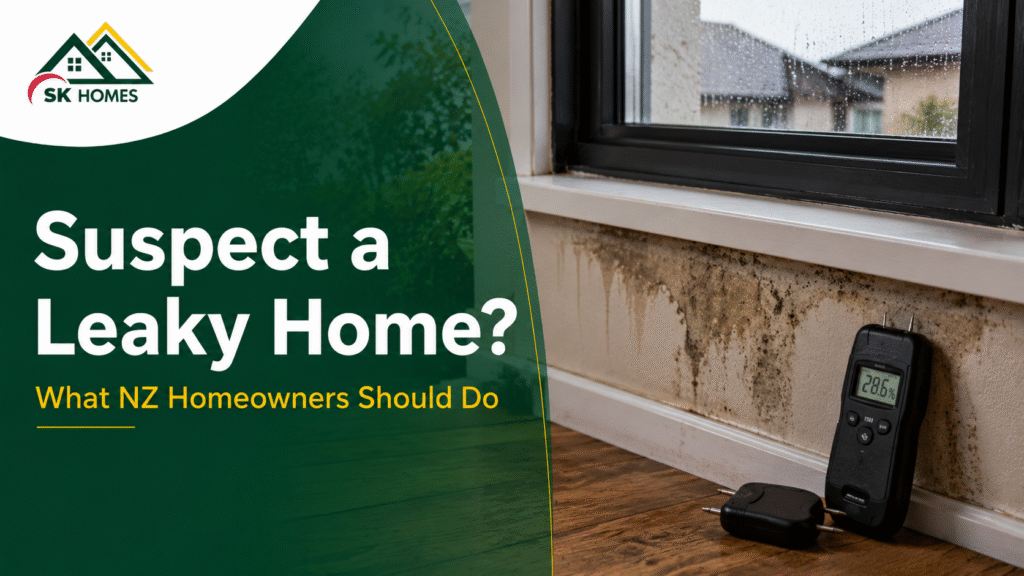
What NZ Homeowners Should Do If They Suspect a Leaky Home
What NZ homeowners should do if they suspect a leaky home is a question that demands quick, methodical action rather than panic.
The realisation that your home might be a leaky building is one of the most stressful moments in NZ property ownership. It might start with something small – a persistent damp smell in a bedroom, paint bubbling at a window reveal, a soft spot in the floor near an external wall. Or it might start with a building inspector’s report that flags elevated moisture readings and recommends further investigation. Either way, the practical question becomes urgent: what do I do now?
This article provides a clear sequence of steps for NZ homeowners who suspect or have identified a weathertightness problem in their property.
Step 1 – Get a Professional Assessment
Before anything else, you need to understand the actual extent of the problem. Your suspicion or the early signs you have noticed may indicate a minor maintenance issue or a significant structural weathertightness failure. Without a professional assessment, you cannot know which it is – and you cannot make informed decisions about remediation, insurance, legal options, or whether to sell the property.
Book a professional building inspection with moisture testing from SK Homes NZ or a specialist weathertightness assessor. For high-risk properties (1992-2004 monolithic cladding), ask specifically about moisture testing at high-risk points and whether invasive probe testing is recommended. The resulting report will give you documented evidence of the current condition of the building.
Step 2 – Understand What You Are Dealing With
Once you have an assessment report, take time to understand the findings before taking action. Key questions to discuss with your inspector:
- Are the moisture readings indicating active, ongoing moisture ingress or historical moisture that has since dried?
- What is the extent of the affected area – is this localised to one wall section or is it widespread?
- What is the likely source of the moisture ingress?
- Is there evidence of structural decay, or is it elevated moisture without visible decay?
- What is the recommended next step – further investigation, targeted repair, or full recladding assessment?
Step 3 – Stop the Source of Water Ingress
If the assessment identifies an active source of moisture ingress, prioritise stopping it. This might mean temporary measures – sealing a cracked cladding joint, patching a failed flashing, or replacing failed sealant at a critical window. The goal at this stage is not full remediation, but stopping active moisture entry so that the building can begin to dry and the damage does not worsen while you plan the remediation.
Do not apply cosmetic surface treatments (painting over cracks, applying sealant over wet surfaces) without addressing the source of moisture. Sealing moisture in is worse than leaving the surface open to dry.
Step 4 – Get a Remediation Scope and Cost Estimate
If the assessment indicates significant weathertightness failure, you need a remediation scope and cost estimate. This requires a specialist weathertightness assessor or a Licensed Building Practitioner (LBP) with specific weathertightness remediation experience to assess the extent of the damage more fully – typically through invasive investigation.
Get at least two quotes from LBP contractors experienced in weathertightness remediation. The quotes should be based on the same scope of work – if they differ significantly, understand why before proceeding. A cheaper quote based on less work may not address all the damage found.
Step 5 – Check Your Insurance Position
Contact your home insurer as soon as you have a professional assessment confirming weathertightness issues. Be aware that most NZ home insurance policies exclude gradual damage and pre-existing construction defects – which means that weathertightness damage that has developed over years may not be covered. However, there are circumstances where elements of a weathertightness claim may be covered, and you need to understand your specific policy before assuming no cover applies.
Do not delay contacting your insurer. Late notification can be a ground for declining a claim. Provide the insurer with the professional assessment report and ask them to confirm in writing what is and is not covered under your policy.
Step 6 – Consider Legal Advice
Depending on the circumstances, you may have legal options. Key situations where legal advice is warranted:
- If you purchased the property recently and the vendor was aware of weathertightness problems that were not disclosed
- If there is a possibility of a building consent authority (council) contribution to the failure – councils have been parties to leaky building claims where their inspection and consent processes failed
- If the property was built or remediated by a contractor who may have liability for defective workmanship
- If you purchased the property with a LIM report or vendor warranty that did not disclose known issues
A property lawyer with weathertightness experience can advise on the limitations periods for claims (which differ depending on the cause of action) and the practical merits of any potential claim.
Step 7 – Plan the Remediation
Once you understand the extent of the damage, have your insurance position clarified, and have considered any legal options, plan the remediation. Key decisions:
- Targeted repair or full recladding? Targeted repair is appropriate where damage is genuinely limited and the surrounding structure is sound. Full recladding is appropriate where damage is widespread or where the building’s risk profile (no eaves, complex roofline) makes targeted repair likely to fail again.
- Replacement cladding system? Where recladding, choose a cavity-drain system that meets the current Building Code requirements. Do not reclad with a direct-fixed monolithic system that replicates the original failure.
- Building consent? All recladding work requires a building consent from the local council. A code compliance certificate at completion is essential.
- Choose an LBP contractor with weathertightness remediation experience and check their licence on the MBIE register.
Frequently Asked Questions
Should I sell my property if it is a leaky building?
This is a complex financial decision that depends on the extent of the damage, remediation costs, current market value, and your personal financial situation. An unremediated leaky building will sell at a significant discount and will have a limited buyer pool. A properly remediated property can be sold at full market value. Get professional financial advice before deciding.
Do I have to disclose a weathertightness problem when selling?
NZ law requires vendors not to actively mislead buyers. Where you have knowledge of a weathertightness problem, actively concealing it from a buyer is likely unlawful. Legal advice from a property solicitor is essential before selling a property with known weathertightness issues. The safest approach is transparent disclosure with full documentation of what is known and any remediation work carried out.
How long does weathertightness remediation take?
A full recladding project on a medium-sized NZ home typically takes four to eight months from building consent application to code compliance certificate, including the construction period. More complex properties or those requiring significant structural repairs may take longer. The property typically remains habitable during remediation unless structural damage is severe.
Can I live in my house while it is being reclad?
In most cases yes, though it is disruptive. The construction process involves removing and reinstating the cladding on the exterior while the interior remains largely intact. Where structural repairs require removal of interior wall linings as well, the affected rooms become temporarily uninhabitable. Your contractor can advise on what to expect for your specific project.
Concerned about weathertightness? Book a professional Pre-Purchase Building Inspection with SK Homes NZ Limited. We identify weathertightness risks and moisture issues in Auckland, Hamilton, and Palmerston North properties. Contact us at info@skhomes.co.nz or visit skhomes.co.nz