
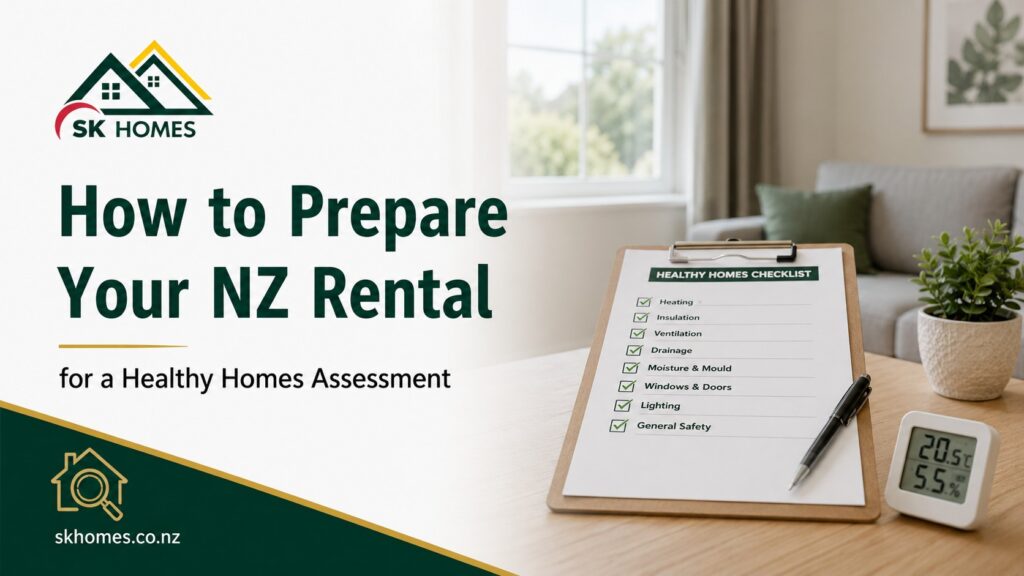
Healthy Homes Assessment Preparation NZ Rental: Landlord Guide
Preparing your rental property for a healthy homes assessment in NZ is one of the most important steps a landlord can take before a new tenancy begins.
A Healthy Homes assessment is a professional inspection of your rental property against all five Healthy Homes Standards – insulation, heating, ventilation, moisture ingress and drainage, and draught stopping. Knowing what to expect before the assessor arrives, and preparing appropriately, helps the process run smoothly and gives you the most useful result.
This checklist covers what to check and prepare for each standard before a Healthy Homes assessment with SK Homes NZ.
Before the Assessment – General Preparation
- Notify your tenant that an assessment is being conducted and arrange access
- Give the required notice under the Residential Tenancies Act (48 hours minimum for routine inspections)
- Ensure the assessor can access all areas of the property including the roof space and subfloor
- Locate any existing insulation certificates, building consents, or records of previous compliance work
- Make sure all keys are available – locked rooms, outbuildings, and subfloor hatches
Insulation – What to Check
The insulation standard requires ceiling and underfloor insulation meeting specific R-values for your climate zone.
- Locate the ceiling access hatch and ensure it is accessible (not blocked by storage)
- If you have existing insulation documentation (installer certificate, build records), have it ready
- Check whether the subfloor hatch is accessible from outside the building
- If you know insulation is present, note the approximate age and type
- If you have foil underfloor insulation, be aware this may or may not meet the current standard – the assessor will check
Heating – What to Check
The heating standard requires a fixed heater capable of achieving 18 degrees Celsius in the main living room.
- Identify the main living room of the property
- Check what fixed heaters are present in that room – heat pump, fixed panel heater, gas heater, wood burner
- If a heat pump is installed, note the model and have the user manual available if possible – the assessor will check the rated output
- If a wood burner is present, note any documentation on its rated output
- If no fixed heater is present in the main living room, note this – it will be a compliance gap
- Measure the floor area of the main living room in square metres – this helps the assessor run the heating calculation on site
Ventilation – What to Check
The ventilation standard requires openable windows in habitable rooms and extractor fans in wet rooms without adequate natural ventilation.
- Check all bedroom and living area windows open fully and are not painted shut or stuck
- Check the kitchen has either a range hood extracting to outside or an extractor fan
- Check all bathrooms – if they have no openable window, they need an extractor fan that vents to outside
- Check that any existing extractor fans are working – switch them on and verify airflow
- Check that range hoods actually duct to outside – some older range hoods recirculate air and do not comply
Moisture and Drainage – What to Check
The moisture standard requires gutters and drainage to direct water away from the building, a ground moisture barrier in the subfloor, and adequate subfloor ventilation.
- Walk around the outside of the property and check gutters are clear of debris and in good condition
- Check downpipes are connected and discharge to drains – not simply onto the ground beside the foundation
- Check the ground around the foundation – it should slope away from the building, not toward it
- Check subfloor vents are open and not blocked by garden growth or debris
- If you can access the subfloor, check whether a polythene moisture barrier is present on the ground
Draught Stopping – What to Check
The draught stopping standard requires unreasonable gaps and holes causing draughts to be sealed, and open fireplaces to be blockable by the tenant.
- Check around all window frames and door frames for visible gaps between the frame and the wall
- Check exterior doors for door seals and threshold strips
- Check skirting boards at floor level for gaps, particularly in rooms with suspended timber floors
- If the property has an open fireplace, check whether there is a damper that closes the flue
- If the fireplace is not in use, consider whether the flue should be blocked
Documents to Have Ready
- Current tenancy agreement
- Existing compliance statement if one has been issued
- Any previous Healthy Homes assessment reports or compliance certificates
- Insulation installation certificates if available
- Heat pump installation records and model information
- Building consent records if relevant work has been done recently
What Happens During the Assessment
The SK Homes NZ assessor will work through the property systematically, checking each standard in turn. The assessment typically takes 60 to 90 minutes for a standard three-bedroom rental. You will receive a written report covering each standard and identifying any compliance gaps with specific recommendations for remediation.
What Happens After the Assessment
Where the property is fully compliant, you will have documented evidence of compliance that supports your compliance statement to new tenants. Where gaps are identified, the report gives you a clear picture of what needs to be addressed and in what priority order. SK Homes NZ can advise on practical remediation options and, where insulation installation is required, can assist with arranging this work.
Frequently Asked Questions
How long does a Healthy Homes assessment take?
For a standard three-bedroom rental, the on-site assessment typically takes 60 to 90 minutes. Larger or more complex properties may take longer. The written report is provided separately after the assessment.
Does the tenant need to be home during the assessment?
The tenant does not need to be home, but must be given the required notice (minimum 48 hours). Landlord access rights apply. If the tenant prefers to be present, that is their right.
How much does a Healthy Homes assessment cost with SK Homes NZ?
SK Homes NZ charges $165 plus GST for a Healthy Homes assessment in Auckland, Hamilton, and Palmerston North. This covers assessment against all five Healthy Homes Standards and a written compliance report.
How often does a Healthy Homes assessment need to be done?
There is no fixed recertification period – compliance is an ongoing obligation rather than a periodic certification. However, as property conditions change over time and as standards may be updated, it is good practice to reassess if significant work has been done to the property, if a new tenancy is starting, or if time has passed since the last assessment.
Book a professional Healthy Homes Assessment with SK Homes NZ Limited. We help landlords in Auckland, Hamilton, and Palmerston North achieve compliance with the Healthy Homes Standards.
📧 info@skhomes.co.nz | 🌐 skhomes.co.nz | 📞 029 045 0464
Related Articles
- How Much Does a Healthy Homes Assessment Cost?
- Who Can Do a Healthy Homes Assessment in NZ?
- The Real Cost of Healthy Homes Non-Compliance
Healthy Homes Assessment Preparation NZ Rental: Key Points for NZ Property Owners
Healthy homes assessment preparation for NZ rental properties is guided by the Residential Tenancies Act requirements published by Tenancy Services NZ, which landlords must meet before each tenancy. For more information, visit Tenancy Services NZ.