
Old Wooden Windows Failing NZ Rental Properties: Compliance Guide
Old wooden windows failing NZ rental properties is a growing compliance issue as the Healthy Homes Standards raise expectations for thermal performance.
Wooden windows have been a feature of New Zealand homes for over a century. In older rentals – particularly those built before the 1980s – they are almost universal. And in many of these properties, they are failing. Not just cosmetically. They are failing the Healthy Homes Standards, failing tenants, and exposing landlords to real compliance risk.
This article explains why old wooden windows are such a significant issue under the Healthy Homes Standards, what the regulations actually require, and what landlords in Auckland, Hamilton, and Palmerston North need to do about it.
Why Wooden Windows Deteriorate
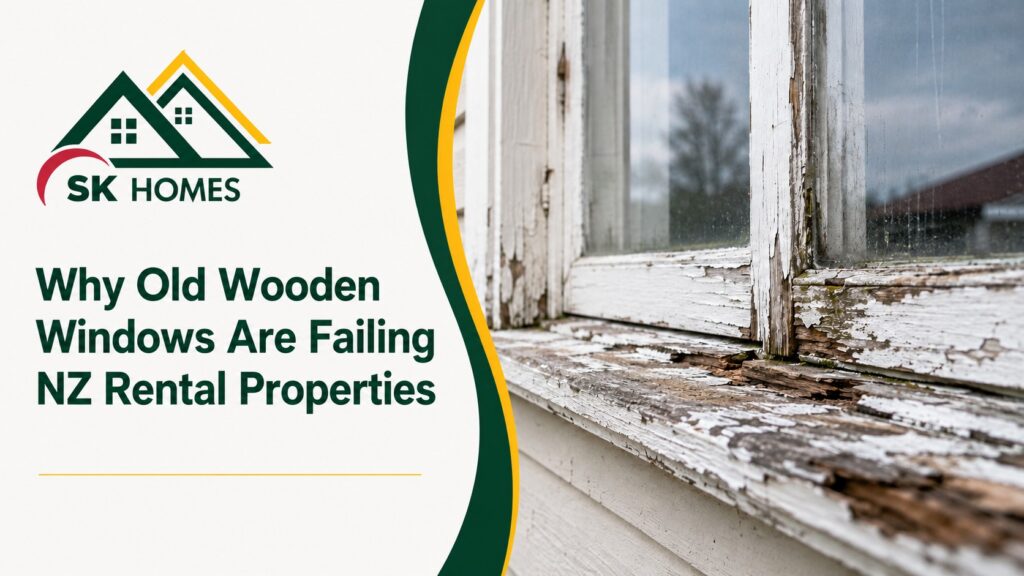
Timber expands and contracts with changes in temperature and humidity. In New Zealand’s variable climate – particularly in Auckland where humidity is high year-round, and in colder inland regions like the Manawatu – this movement is significant. Over decades, wooden window frames warp, twist, and shrink. Gaps open up between the frame and the surrounding wall. Sashes no longer sit flush. Paint peels away from the timber, allowing moisture to penetrate and accelerate the deterioration.
The result is a window that leaks air. In some older Auckland rentals, the gap around a single wooden window frame can be equivalent to leaving a small window open permanently. Multiply that across every window in the house and the heating load on the property becomes enormous – and the ability of any fixed heater to reach the 18 degree Celsius standard becomes severely compromised.
The Draught Stopping Standard and What it Requires
Under the Residential Tenancies (Healthy Homes Standards) Regulations 2019 – specifically the Draught Stopping Standard – landlords must stop all unreasonable gaps and holes in walls, ceilings, floors, and around windows and doors that cause draughts. The regulation uses the word “unreasonable” deliberately. Minor air movement through a building is normal and some ventilation is necessary. What the standard targets is uncontrolled, unintended airflow that makes a property difficult to heat and uncomfortable to occupy.
For old wooden windows, the gaps most commonly found during a Healthy Homes assessment are:
- Gaps between the window sash and frame where the timber has shrunk or warped
- Gaps between the window frame and the surrounding wall framing or lining
- Gaps where the original draught-strip seal has deteriorated or been removed
- Gaps where putty has cracked and fallen away from the glazing rebate, allowing air around the glass
A Healthy Homes assessor will check all windows during the draught stopping assessment. Where gaps are present and unreasonable airflow is occurring, the landlord is required to address them.
Condensation – The Single Glazing Problem
Old wooden windows are almost always single glazed. Single glazing has a very low thermal resistance – the inside surface of the glass gets cold quickly when outdoor temperatures drop. Warm moist air inside the house hits that cold glass surface and water vapour condenses. This is the condensation that appears on windows every cold morning in older NZ homes.
The condensation itself is not just an inconvenience. It runs down the glass, collects on the wooden frame, and sits in the rebate and on the windowsill. Over time this continuous moisture exposure causes the timber to soften, rot, and support mould growth. Mould on window frames and the adjacent wall surfaces is extremely common in Auckland rentals with old single-glazed wooden windows.
Under the Healthy Homes Ventilation Standard, properties must have openable windows in all habitable rooms. The ventilation standard does not directly address condensation – but the moisture it causes connects directly to the Moisture Ingress and Drainage Standard, and the mould that follows has clear implications for tenant health.
What Assessors Look for During a Healthy Homes Inspection
During a Healthy Homes assessment, SK Homes NZ checks all windows against the relevant standards. For old wooden windows specifically, we assess:
- Whether the windows open – and whether the openable area meets the ventilation standard requirement (at least 5% of the floor area of the room for most habitable spaces)
- Whether draughts are present around the frame or sash
- Whether seals or draught strips are present, intact, and functional
- The condition of the putty and glazing
- Visible condensation damage – staining, mould, or softening of the timber
- Whether the window frame has deteriorated to the point where draught stopping is no longer reasonably practicable without replacement
What Landlords Must Do – Practical Options
Option 1 – Draught Strip and Seal (Low Cost)
For windows that are in reasonable structural condition but have gaps due to shrinkage or worn seals, applying new draught-strip sealing around the sash and frame is the lowest cost remediation. Foam, rubber, or brush seals are available from hardware stores and a competent handyman can fit them in a few hours per property. Expect to pay $200 to $600 per property depending on the number of windows.
Option 2 – Reputty and Repaint
Where putty has failed around the glazing, reputting and repainting the frame stops air movement around the glass and protects the timber from further moisture damage. This is often combined with draught strip installation as part of a general window maintenance programme. Budget $100 to $300 per window depending on condition.
Option 3 – Window Replacement
Where frames have deteriorated beyond practical repair – significant rot, severe warping, or frames that have shifted out of square – replacement is the appropriate solution. Modern double-glazed aluminium or uPVC windows eliminate draught issues and dramatically reduce condensation. Window replacement in New Zealand typically costs $800 to $2,500 per window installed, depending on size, type, and access. For a full property with 10 windows, budget $10,000 to $20,000 or more.
Replacement windows are not specifically required by the Healthy Homes Standards – the standard requires draught stopping, not glazing upgrades. However, where frames are in such poor condition that sealing alone cannot achieve compliance, replacement becomes the practical path to compliance.
Exemptions and Special Cases
The draught stopping standard includes a reasonableness test. Where stopping a draught is not “reasonably practicable” – for example where access is not possible, or where the cost is wholly disproportionate to the benefit – the landlord may not be required to address it. However, the threshold for “not reasonably practicable” is high. Simple draught strip installation around standard windows will rarely qualify for exemption.
Compliance Timeframes
All private landlords in New Zealand must comply with the Healthy Homes Standards. Where a property has an existing tenancy, compliance must be achieved within the timeframes set under the Residential Tenancies Act. A new tenancy from 1 July 2021 must comply from the start of the tenancy. All private rental properties were required to comply by 1 July 2025. If your property has not yet been assessed, it should be – enforcement through the Tenancy Tribunal is active.
Tenant Rights
Tenants have the right to a property that complies with the Healthy Homes Standards. If a landlord fails to meet the standards, tenants can apply to the Tenancy Tribunal for a work order requiring compliance, and for exemplary damages of up to $4,000. Landlords who provide false statements about compliance can face penalties of up to $1,500. The compliance statement provided at the start of each tenancy is a legal document.
Frequently Asked Questions
Do I have to replace wooden windows to comply with the Healthy Homes Standards?
Not necessarily. The standard requires draught stopping, not window replacement. If draught strips and sealing can achieve compliance, replacement is not required. Where frames are severely deteriorated and sealing alone cannot address the draught, replacement may become the practical solution.
Are single-glazed windows non-compliant under Healthy Homes?
Single glazing is not specifically prohibited by the Healthy Homes Standards. The standards address heating capacity, draught stopping, and ventilation – not glazing type. However, single glazing contributes to condensation and heat loss in ways that affect compliance with other standards.
How do I know if my windows are causing a draught compliance issue?
A Healthy Homes assessment by SK Homes NZ will check all windows and identify any draught stopping issues. This is the most reliable way to establish your compliance position.
How much does it cost to draught-proof windows in a typical Auckland rental?
For a property with 8 to 10 windows requiring draught strip installation, expect to pay $300 to $800 for materials and labour. Where windows also need reputting and repainting, add $100 to $300 per window.
Can tenants be held responsible for condensation damage to wooden windows?
Tenants have a responsibility to ventilate the property and keep it reasonably clean. However, where condensation is caused by single glazing and structural issues rather than tenant behaviour, the landlord carries primary responsibility for the condition of the building fabric.
Book a professional Healthy Homes Assessment with SK Homes NZ Limited. We help landlords in Auckland, Hamilton, and Palmerston North achieve compliance with the Healthy Homes Standards.
📧 info@skhomes.co.nz | 🌐 skhomes.co.nz | 📞 029 045 0464
Related Articles
- Single Glazed Windows in NZ Rentals
- Draught Stopping in Older NZ Homes
- The Healthy Homes Standards NZ: A Complete Guide
Old Wooden Windows Failing NZ Rental Properties: Key Points for NZ Property Owners
Old wooden windows failing NZ rental properties is increasingly identified in Tenancy Services NZ compliance assessments, where thermal performance affects the calculated heating requirement under the Healthy Homes Standards. For more information, visit Tenancy Services NZ.