
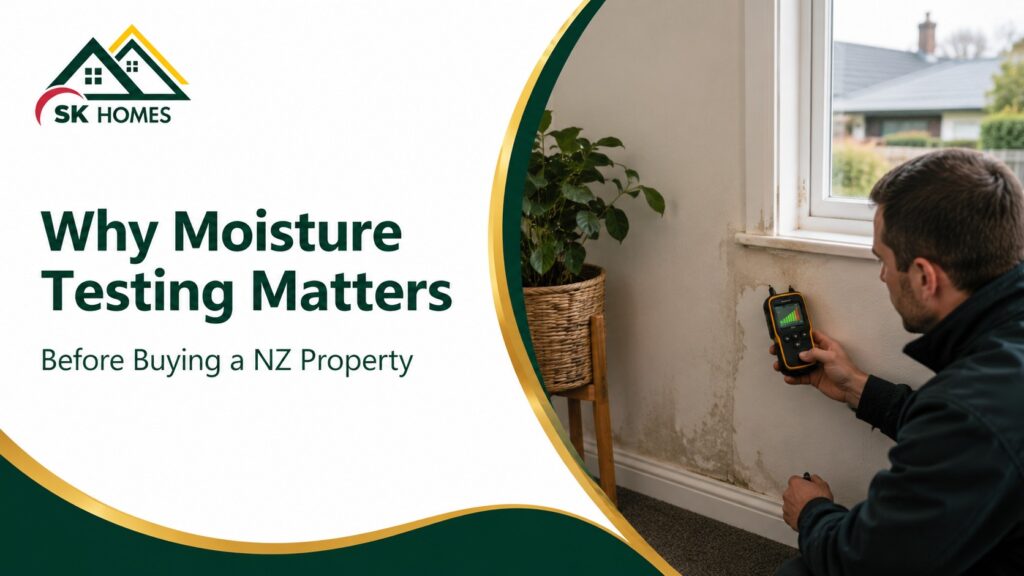
Moisture Testing Before Buying NZ Property: Why It Matters
Moisture testing before buying a NZ property is one of the most effective ways to detect hidden weathertightness damage that a visual inspection alone cannot find.
A freshly painted exterior tells you very little about the condition of the wall framing behind it. In Auckland, where thousands of homes from the leaky building era are still on the market – some with cosmetic repairs that mask deeper problems – moisture testing is one of the most valuable tools available to a home buyer.
What is Moisture Testing?
Moisture testing uses a calibrated moisture meter to measure the moisture content of building materials – primarily timber framing and wall linings – at specific points around the property. Readings above certain levels indicate that water has penetrated the building envelope and is present within the wall system, even when there is no visible surface damage.
Two types of moisture meters are used. Pin-type meters penetrate the surface to take a direct reading of the material. Non-invasive capacitance meters read through the surface without penetrating it. SK Homes NZ uses calibrated moisture meters appropriate to the specific assessment requirements.
Why Auckland Buyers Need Moisture Testing
Auckland’s high rainfall, humid climate, and large number of 1994-2004 era properties with monolithic cladding make it New Zealand’s highest-risk city for hidden moisture damage. A property can look completely normal from the outside and yet have significant timber rot within the wall framing – because the damage occurs where no one can see it without looking specifically for it.
By the time moisture damage becomes visible on the surface, the structural damage behind it is often already extensive. Moisture testing catches the problem while it is still possible to make an informed purchase decision.
Where Readings Are Taken
During a moisture testing assessment, readings are taken at the locations most likely to show elevated moisture if the building envelope has failed:
- Below and beside windows – the window-to-cladding junction is a primary water entry point
- At roof-to-wall junctions and below parapets
- Around balconies and where balustrades connect to the wall
- At the base of walls and at the cladding-to-foundation junction
- At building corners and internal angles
- Around penetrations – pipes, vents, and electrical fittings in external walls
- In the subfloor – floor framing, pile bases, and ground level
- Adjacent to showers and baths in wet areas
What the Readings Mean
Moisture content in timber is expressed as a percentage. General interpretation guidance:
- Below 16% – generally acceptable, low risk of fungal decay
- 16% to 19% – elevated, monitoring and further investigation warranted
- 20% and above – conditions suitable for fungal growth and structural decay – specialist investigation strongly recommended before purchase
When to Arrange Moisture Testing
SK Homes NZ recommends moisture testing for any Auckland property that:
- Was built between approximately 1994 and 2004
- Has monolithic or plaster-finish cladding
- Has complex architectural features including parapets, internal gutters, or enclosed balconies
- Shows any visible signs of staining, cracking, or surface deterioration on the cladding
- Has weathertightness claims or prior repairs noted in the LIM report
It can also add value for properties outside this era where the visual inspection raises concerns about moisture management or drainage.
Frequently Asked Questions
Is moisture testing the same as a weathertightness investigation?
No. Moisture testing is a non-invasive screening tool. A specialist weathertightness investigation goes further and may include invasive testing – opening sections of cladding to directly inspect the framing. If moisture testing shows elevated readings, a specialist investigation is the recommended next step.
Can a property pass moisture testing and still have damage?
Moisture testing is taken at accessible points and may not cover all areas of the building. Passing results reduce risk but do not guarantee the absence of moisture issues in areas that could not be tested. The report will note any limitations on the assessment.
Can moisture testing be added to a standard pre-purchase inspection?
Yes. SK Homes NZ offers moisture testing as part of the pre-purchase inspection for at-risk properties. Contact us to discuss your specific property and requirements.
Book a pre-purchase inspection with moisture testing at SK Homes NZ Limited. Serving Auckland, Hamilton, and Palmerston North.
📧 info@skhomes.co.nz | 🌐 skhomes.co.nz | 📞 029 045 0464
Related Articles
- Hidden Moisture Damage in NZ Homes
- What is a Pre-Purchase Building Inspection in NZ?
- What Is a Weathertightness Assessment?
Moisture Testing Before Buying NZ Property: Key Points for NZ Property Owners
Moisture testing before buying NZ property is strongly recommended by BRANZ, whose research into weathertightness failure in New Zealand homes shows that moisture ingress is consistently underdetected by visual inspection alone. For more information, visit BRANZ.