
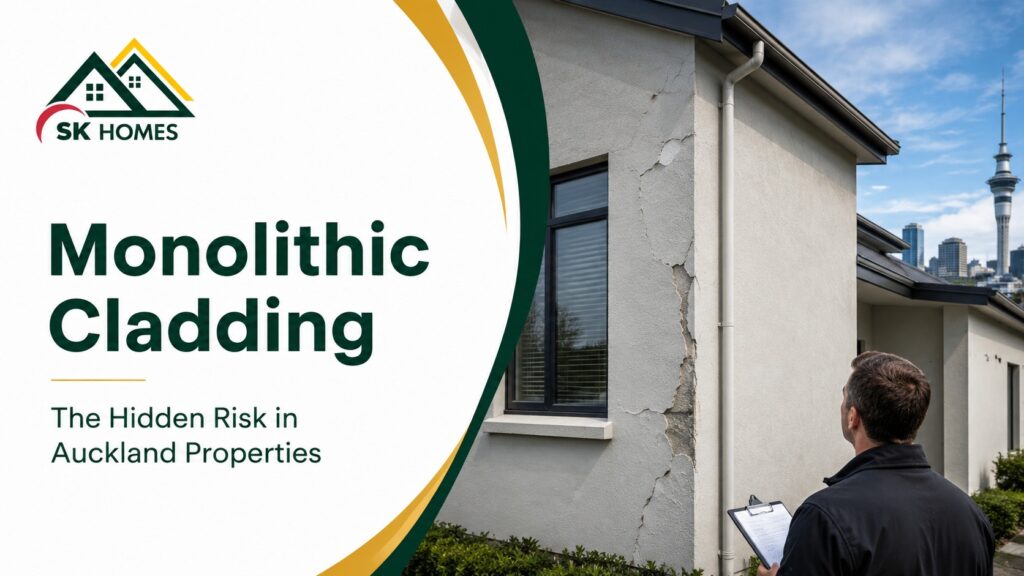
Monolithic Cladding Hidden Risk Auckland Properties: Buyers Guide
Monolithic cladding presents a hidden risk in Auckland properties that property buyers often do not fully appreciate until a professional weathertightness assessment is completed.
Monolithic cladding presents a hidden risk in Auckland properties that property buyers often do not fully appreciate until a professional weathertightness assessment is completed.
Walk through a typical Auckland suburb and you will see them everywhere – smooth plastered exteriors, Mediterranean rooflines, balconies with rendered balustrades. These are the visual signatures of the monolithic cladding era, and for buyers, they are a prompt to look much more carefully before purchasing.
What is Monolithic Cladding?
Monolithic cladding is any exterior wall cladding system that presents a continuous, seamless surface. Common types used in New Zealand include stucco (cement plaster), EIFS (Exterior Insulation and Finish Systems, often called polystyrene cladding), and fibre cement sheet. Unlike weatherboards, these systems have no visible joints or overlaps – the surface is unbroken.
The problem is not the material itself. The problem is how these systems were installed during the 1994-2004 period – directly onto the structural framing without a drainage cavity. In a direct-fix installation, any water that gets behind the cladding has nowhere to go. It sits against the framing, keeping the timber permanently wet, and decay follows.
Cavity vs Direct-Fix – The Critical Difference
Modern monolithic cladding installations include a 20mm drainage cavity between the cladding and the building wrap. Water that penetrates the cladding drains down through this cavity and out at the base. The wall system can breathe and dry out.
Direct-fix installations – common in the high-risk period – have no such cavity. The cladding sits directly on the framing. There is no drainage path and no drying mechanism. Moisture accumulates and the timber deteriorates over time, often invisibly.
Determining whether a monolithic cladding system is cavity or direct-fix from a visual inspection is not always straightforward. The installation method can sometimes be inferred from the property age and the cladding system used. In other cases, a specialist investigation is needed to confirm it.
Architectural Features That Increase the Risk
Monolithic cladding risk is significantly amplified by certain design features. During every inspection, SK Homes NZ specifically checks for:
- Parapets – walls that extend above the roofline, requiring waterproofing at the top that was frequently inadequate
- Internal box gutters – built within the roof structure, prone to overflow into the building when blocked or undersized
- Balconies with monolithic balustrades – a very high-risk junction where water regularly penetrates
- Low-pitched or flat roofs – reduced drainage and higher ponding risk
- Recessed windows without adequate head flashings
- Complex rooflines with multiple junctions and angles
- Enclosed soffits that hide the roof-to-wall junction
What to Look for on the Day
During a pre-purchase inspection, SK Homes NZ looks closely for visible signs that water has penetrated the cladding. Key indicators include:
- Cracking in the cladding at corners, around windows, and at control joints
- Staining on the exterior surface, particularly below windows or at junctions
- Bubbling, blistering, or delamination of the paint or coating
- Staining on interior walls near windows or external walls
- Soft or uneven flooring near external walls
- Musty or earthy odours inside the building
- Visible mould on interior surfaces
- Corroded or missing flashings at any junction
A fresh coat of paint can hide many of these signs. That is why moisture testing matters for any monolithic cladding property – it provides data the eye cannot.
Moisture Testing for Monolithic Cladding Properties
For any Auckland property with monolithic cladding, SK Homes NZ recommends moisture testing alongside the visual inspection. Using a calibrated moisture meter, readings are taken at the most vulnerable points – below windows, at balcony connections, at the base of walls, around penetrations, and at any junctions. Elevated readings confirm that moisture has penetrated the wall system and that further specialist investigation is needed before purchase.
What to Do if You Are Buying a Monolithic Cladding Property
- Arrange a pre-purchase building inspection by an inspector familiar with Auckland leaky building issues
- Request moisture testing as part of the inspection
- Obtain and read the LIM report, checking for any weathertightness claims on record
- If moisture is detected, commission a specialist weathertightness investigation before going unconditional
- Obtain remediation quotes before finalising any price negotiation
- Verify that any prior remediation work has building consent and a code compliance certificate
Frequently Asked Questions
Is all monolithic cladding a problem?
No. Modern monolithic cladding installed with a proper drainage cavity and correctly detailed flashings can perform well. The high-risk category is direct-fix monolithic cladding from the 1994-2004 period without adequate cavities.
How do I identify monolithic cladding?
Look for a smooth, continuous plastered or rendered exterior without visible weatherboard joins. A building inspector can confirm the cladding type and assess the risk during a pre-purchase inspection.
Can monolithic cladding be fixed?
Yes – but full remediation is expensive. It typically involves stripping the cladding, replacing damaged framing, and installing new cladding with a proper drainage cavity. Costs range from $50,000 for minor work to over $300,000 for extensive damage.
Book a pre-purchase inspection with moisture testing at SK Homes NZ Limited. Serving Auckland, Hamilton, and Palmerston North.
📧 info@skhomes.co.nz | 🌐 skhomes.co.nz | 📞 029 045 0464
Related Articles
- The NZ Leaky Building Crisis
- What Is a Weathertightness Assessment?
- Hidden Moisture Damage in NZ Homes
Monolithic Cladding Hidden Risk Auckland Properties: Key Points for NZ Property Owners
Monolithic cladding hidden risk in Auckland properties is well documented in BRANZ research on weathertightness failure, which identifies certain cladding types, roof forms, and building details as predictors of moisture damage. For more information, visit BRANZ.